
Sheesham vs Teak vs Engineered Wood vs MDF: Which Furniture Material Is Actually Worth Your Money in India?
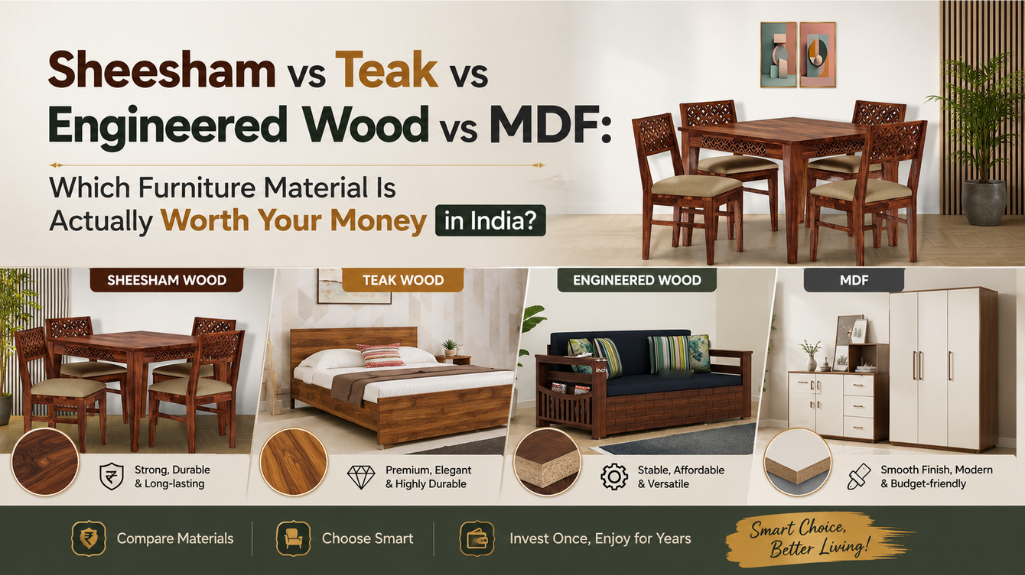
You are shopping for a dining table online. One listing says sheesham wood. Another says engineered wood. A third says MDF with a teak veneer. A fourth says solid acacia. None of the product descriptions tell you what any of this actually means in terms of how long the table will last, how it handles the Indian climate, or whether it justifies the price difference.
This is one of the most common points of confusion for Indian furniture buyers and it costs people real money. Buying MDF furniture expecting it to perform like solid wood is a disappointment. Paying a solid wood premium for a wardrobe that will be in a damp bathroom alcove where even teak would struggle is unnecessary overspending. The material matters but so does matching the material to the room, the use case and the climate zone you live in.
This guide breaks down every furniture material you will encounter in the Indian market. What each one is made from, how it performs in Indian conditions, what it genuinely costs, which rooms and furniture types it suits, and what the honest limitations are. Read this once and you will never be confused by a furniture product listing again.
Solid Wood Furniture in India
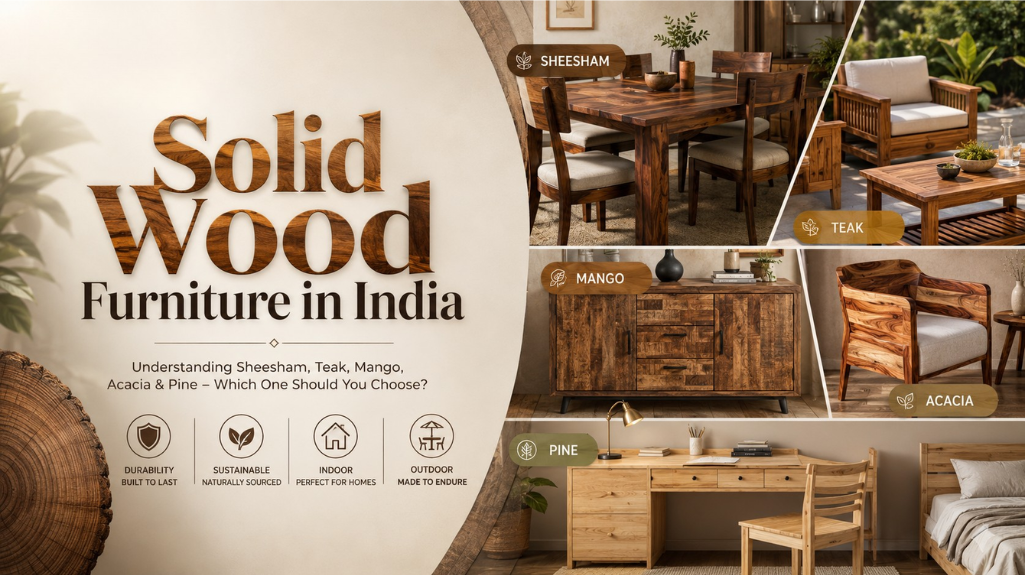
Solid wood furniture is made from planks cut directly from timber. No bonding agents, no composite cores, no veneers. The grain you see on the surface goes all the way through the piece. This is why solid wood can be sanded and refinished multiple times over its lifespan, something no engineered wood product can match.
In India, several wood species are commonly used for furniture. Each has distinct characteristics that make it more or less suitable for different rooms and different climates.
Sheesham (Indian Rosewood)
Sheesham is the most widely used solid wood for furniture in India and for good reason. It grows abundantly in North India, particularly in Punjab, Haryana and Uttar Pradesh, which keeps prices more accessible than imported hardwoods. The wood has a beautiful grain pattern with natural golden to dark brown tones that deepen and enrich with age. It is dense, naturally resistant to termites and handles the dry heat of North Indian summers well.
Sheesham is a genuinely hard wood, which means it does not dent or scratch easily. Dining tables, sofa frames, bed frames and wardrobes made from sheesham are all excellent choices and represent the best value-to-quality ratio in Indian solid wood furniture. The one limitation of sheesham is that it can show some sensitivity to very high humidity environments over many years, so it is best kept indoors with some climate control rather than in semi-outdoor or permanently humid spaces.
| Best for: Dining tables, bed frames, sofa frames, wardrobes and living room furniture in homes across North, Central and Western India. Ideal for buyers who want real solid wood at a mid-range price point. |
Teak (Sagwan)
Teak is the most prized furniture wood in India and has been for centuries. Its natural oil content makes it uniquely resistant to water, insects, rot and cracking. Teak furniture handled correctly will outlast almost any other furniture material available. It is the only wood that handles outdoor Indian conditions reliably without heavy chemical treatment, which is why it is the default choice for garden and terrace furniture.
For indoor furniture, teak’s durability is unmatched but the cost reflects that. Genuine Grade A teak furniture from a reputable source carries a significant premium over sheesham. The market also has a considerable amount of low-grade or plantation teak that is softer, lighter in colour and less durable than the benchmark wood properties teak is famous for. When buying teak furniture, weight is your best on-the-spot quality check: genuine high-grade teak is noticeably heavier than plantation teak or wood described vaguely as teak-finished.
| Best for: Outdoor furniture, premium indoor bedroom furniture, dining sets intended for multi-decade use. Worth the price if you are furnishing a home for the long term and want furniture you will not need to replace within your lifetime. |
Mango Wood (Mango Teak)
Mango wood has become increasingly popular as a sustainable and affordable solid wood alternative in Indian furniture over the last decade. Mango trees are harvested at the end of their fruit-bearing life, which makes the wood an environmentally responsible choice. The grain patterns in mango wood are varied and distinctive, often with dark streaks and colour variations that give furniture a natural, characterful appearance.
As a furniture material, mango wood is reasonably hard and durable but less dense than sheesham or teak. It is more susceptible to moisture absorption than teak and should be sealed properly for use in any room with moderate to high humidity. Mango wood furniture is a strong choice for living rooms, study rooms and dining rooms where aesthetic appeal and budget efficiency both matter.
Acacia Wood
Acacia is a hardwood with a distinctive grain and natural golden-brown colour. It is denser than mango wood and offers better moisture resistance, making it a solid mid-tier choice between mango and sheesham. Acacia furniture is popular in premium home decor because the grain patterns can be visually striking. Like mango wood, acacia benefits from regular oiling to maintain its surface finish and moisture resistance over time.
Pine Wood
Pine is a softwood that is light in colour, lightweight in weight and significantly cheaper than the hardwoods listed above. It is commonly used in children’s furniture, study furniture and bedroom furniture where cost is the priority. The trade-off is durability: pine dents and scratches more easily than hardwoods and is more susceptible to humidity-related expansion in Indian conditions. Pine furniture can serve well for 4 to 6 years with reasonable care but is not a long-term investment material.
Engineered Wood Furniture in India
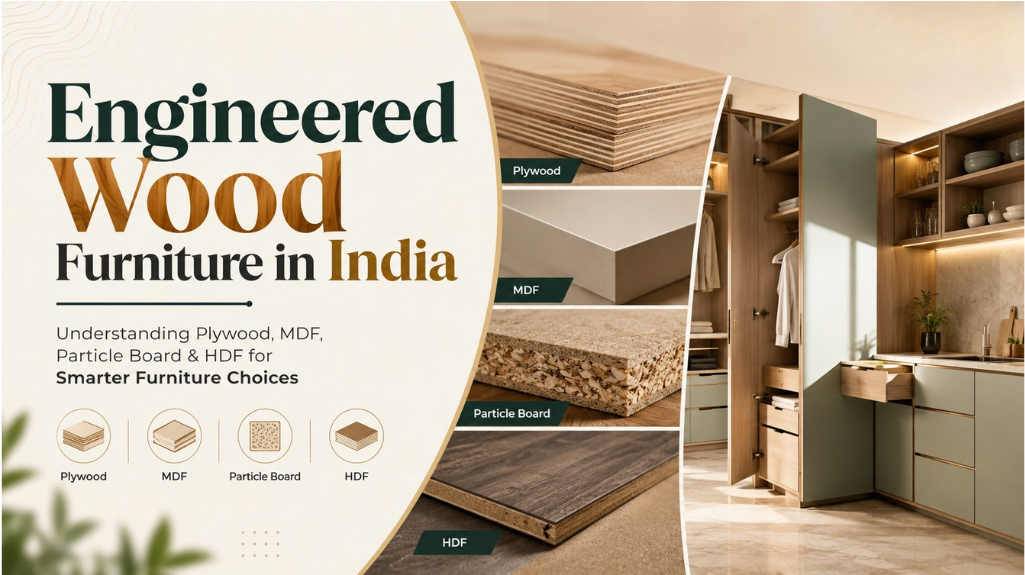
Engineered wood is a broad category that covers several different manufactured wood products. They are made by binding wood fibres, particles or veneers together with adhesives under heat and pressure. The result is a material that uses wood but behaves differently from solid wood in several important ways.
Engineered wood products are not inherently inferior to solid wood. They are different. Understanding what each type is and what it is suited for is the key to making good purchasing decisions.
Plywood
Plywood is made by gluing thin sheets of wood veneer together in alternating grain directions. This cross-grain construction gives plywood excellent strength, dimensional stability and resistance to warping. Good quality plywood (particularly BWR grade, which stands for boiling water resistant) handles moisture significantly better than other engineered wood products.
Plywood is the most structurally sound of all engineered wood options and is the material of choice for the internal carcass of most Indian modular kitchen units and wardrobe interiors. It can carry weight well, accepts screws reliably and does not sag over time the way particle board does. When buying wardrobes or kitchen units, check whether the carcass (the box structure) is made from plywood or particle board. This single specification has more impact on long-term durability than almost any other.
| Key specification to check: When buying wardrobes, kitchen units or any box furniture, always ask whether the carcass is BWR plywood or particle board. BWR plywood costs more but handles Indian humidity significantly better and lasts much longer. Particle board in a humid room or bathroom-adjacent wardrobe will swell and degrade within a few years. |
MDF (Medium Density Fibreboard)
MDF is made from fine wood fibres mixed with resin and compressed into flat sheets. The surface of MDF is exceptionally smooth and uniform, which makes it the best substrate for painted furniture and lacquer finishes. MDF edges can be milled into complex profiles, which is why most decorative furniture with intricate detailing, carved-look edges or smooth painted surfaces uses MDF.
The honest limitation of MDF is its relationship with moisture. Standard MDF swells when it gets wet and does not recover. Once swollen, MDF furniture looks permanently damaged. This makes standard MDF unsuitable for bathrooms, outdoor use, kitchen areas near sinks or any consistently humid environment. Moisture-resistant MDF (MR MDF) performs somewhat better but still requires sealing and should not be used in direct-moisture contact.
For living room and bedroom furniture that stays dry, MDF is a very functional and cost-effective material. For any location with moisture exposure, plywood or solid wood is the better choice.
Particle Board (also called Chipboard)
Particle board is made from wood chips and sawdust bonded with resin. It is the lowest-cost engineered wood product and is very widely used in budget furniture across India. It is heavier than MDF and plywood, has poor screw-holding strength (screws pull out of particle board more easily than from plywood or solid wood) and is the most susceptible of all wood products to moisture damage.
Particle board furniture in a dry, stable environment can last 5 to 8 years with reasonable care. In a humid environment, the timeline shortens considerably. The biggest concern with particle board is that it is frequently used even in furniture sold at mid-range prices without being disclosed clearly. If a product listing does not specify the material and the price seems unusually low for the size of the piece, particle board is the most likely explanation.
HDF (High Density Fibreboard)
HDF is a denser, harder version of MDF. It is commonly used for laminate flooring cores and door skins. In furniture, HDF is sometimes used for drawer bottoms, cabinet backs and thin structural panels. It is harder and more scratch-resistant than MDF on the surface but shares the same moisture sensitivity. You are unlikely to see HDF listed as the primary material of a furniture piece; it appears most often as a component material within a larger construction.
The Full Material Comparison Table
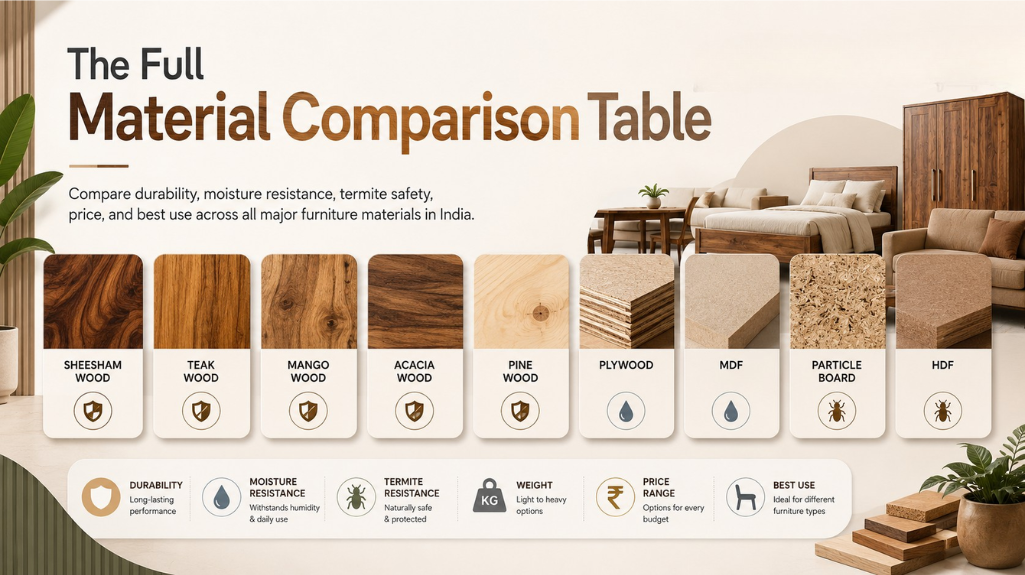
Here is a side-by-side comparison of every furniture material covered in this guide across the specifications that matter most for Indian buyers.
| Material | Durability | Moisture Resistance | Termite Resistance | Repairability | Weight | Price Range | Best Use |
| Sheesham | Excellent | Good | Very good | Excellent | Heavy | Mid | Beds, sofas, dining, wardrobes |
| Teak | Outstanding | Excellent | Excellent | Excellent | Very heavy | Premium | Outdoor, premium indoor all rooms |
| Mango Wood | Good | Moderate | Good | Good | Medium | Budget to Mid | Living room, dining, study |
| Acacia | Good | Good | Good | Good | Medium | Mid | Dining, living room |
| Pine | Moderate | Low | Low | Moderate | Light | Budget | Children’s furniture, study room |
| Plywood (BWR) | Very good | Very good | Moderate | Limited | Medium | Mid | Wardrobe carcass, kitchen units |
| MDF | Good | Poor (Std) | Moderate | Limited | Heavy | Budget to Mid | Painted furniture, dry rooms only |
| Particle Board | Moderate | Poor | Low | Poor | Very heavy | Budget | Dry rooms, low-use furniture |
| HDF | Good | Poor | Moderate | Limited | Heavy | Budget to Mid | Drawer bottoms, door skins, flooring |
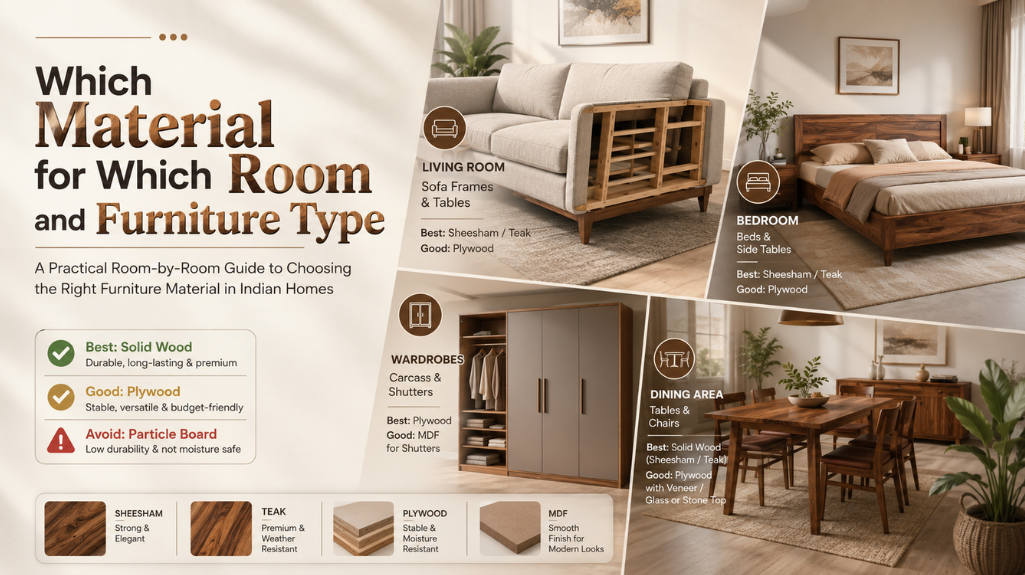
Which Material for Which Room and Furniture Type
Matching the right material to the right room and use case is where most buying decisions get made well or badly. Here is a room-by-room and furniture-type breakdown.
Sofa frames
The frame of a sofa is hidden under upholstery so buyers rarely ask about it, but it is the most important structural element of any sofa. A sofa frame made from sheesham or teak will stay solid and stable for 10 to 15 years and can survive reupholstery. A sofa frame made from particle board or low-grade plywood will creak, loosen at the joints and ultimately collapse under regular use within 4 to 6 years.
When buying a sofa, always ask what the frame material is. Reputable furniture brands will answer clearly. Brands that deflect the question or describe the frame vaguely as wood frame without specification are the ones to be cautious about. Sheesham or kikar (acacia) frames are the standard for well-made mid-range sofas in India. Teak frames are found in premium sofas.
Bed frames
Beds carry a significant and repeated load, including the weight of sleepers, mattresses and the regular impact of people sitting on the edges. Solid wood, particularly sheesham, is the right material for bed frames intended to last. Engineered wood beds in plywood are an acceptable and common choice at the mid-range level provided the construction quality is good.
Avoid beds with particle board frames unless the budget is very tight and the expected use is light. The legs and joint connections of particle board beds are the first areas to show failure, and a bed that wobbles or creaks is a problem that will not improve with time.
Wardrobes
Wardrobes have two structural elements that need to be assessed separately: the door and the carcass (the box interior). The door can be MDF with a laminate or lacquer finish without any problem because doors are not load-bearing and stay dry in most situations. The carcass that carries the weight of shelves, hanging clothes and drawers is the critical part.
BWR plywood for the wardrobe carcass is the specification worth paying for. It handles the weight without sagging over time and resists the humidity that bedroom wardrobes encounter in Indian homes, particularly in coastal cities or during monsoon months. A wardrobe with a plywood carcass and MDF or solid wood doors is the best all-round construction for Indian bedrooms.
Dining tables
Dining tables need a hard, scratch-resistant surface that handles spills and daily contact. Solid sheesham or teak with a good quality finish are the best dining table tops. Acacia and mango wood are good alternatives. A stone or glass top on a solid wood base is another premium option that performs very well in the Indian context because the top surface never absorbs spills.
MDF dining tables with a lacquer top can look beautiful initially but the surface chips at the edges over time with daily use and does not refinish the way solid wood does. For a piece of furniture that sees daily, heavy use, invest in solid wood for the dining table before any other piece in the home.
| Furniture Type | Recommended Material | Acceptable Alternative | Avoid |
| Sofa frame | Sheesham, kikar (acacia), teak | Good quality plywood frame | Particle board frame, MDF frame |
| Bed frame | Sheesham, teak | BWR plywood construction | Particle board, standard MDF |
| Wardrobe | Plywood carcass, MDF or solid door | All-plywood construction | Particle board carcass |
| Dining table | Solid sheesham, teak, acacia | Stone or glass top on wood base | MDF top for daily use |
| Study table | Sheesham, plywood, MDF (dry room) | Mango wood, acacia | Particle board for heavy-use desk |
| Bookshelf | Plywood, sheesham | MDF in dry room only | Particle board for heavy book loads |
| Children’s room | Mango, pine, plywood | MDF in dry rooms | Particle board, any low-quality material |
Indian Climate and Furniture Materials
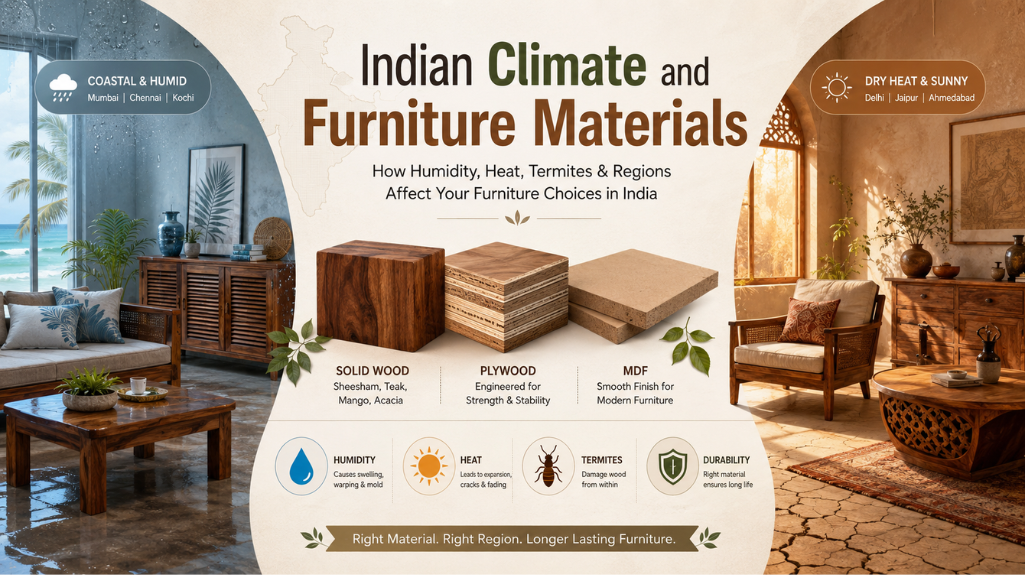
India’s climate creates specific challenges for furniture that no other country’s furniture guides address. Humidity, heat, monsoon moisture, coastal salt air and termite pressure all affect different materials differently. Here is what you need to know based on where you live.
Humidity and moisture (coastal cities and monsoon regions)
Mumbai, Chennai, Kochi, Kolkata and other coastal or high-humidity cities are the most demanding environments for furniture materials. In these cities, MDF and particle board have the shortest useful lives and should be avoided in any room without year-round air conditioning. Solid wood, particularly teak and well-sealed sheesham, performs best. BWR plywood is the right choice for any wardrobe or storage unit interior. Furniture finishes matter here too: PU lacquer and melamine finishes seal the wood surface better than wax or oil finishes in high-humidity environments.
Dry heat (North and Central India)
Delhi, Jaipur, Nagpur, Bhopal and similar dry-climate cities are harder on furniture in the opposite way. Extreme dry heat causes wood to lose moisture and crack if it is not properly seasoned and finished. Sheesham is particularly well-suited to this climate because it is naturally acclimatised to these conditions. Teak handles dry heat excellently. MDF and particle board perform reasonably well in dry climates because moisture is the lesser concern, though they still cannot be sanded or refinished the way solid wood can.
Termites
Termite damage is a real and under-discussed risk for furniture in Indian homes, particularly in ground-floor units, older buildings and homes in high-moisture areas. Teak and sheesham have natural properties that make them less attractive to termites. Engineered wood products vary in termite resistance based on the adhesives and treatments used in their manufacture. If your home has a history of termite activity, prioritise solid wood furniture, use anti-termite sprays during construction or renovation, and ensure any engineered wood furniture you buy is treated with anti-termite chemicals.
How to identify real solid wood versus MDF or particle board when buying online
Online furniture shopping makes material verification difficult. Here are practical checks you can use:
- Weight per piece: Solid wood is heavier per unit than MDF and particle board per unit volume. If a large dining table is described as solid wood but the product weight seems unusually low, ask for clarification.
- Price anchor: Genuine solid sheesham furniture in a standard size has a realistic price floor. A 6-seater dining table in sheesham below Rs 18,000 to Rs 20,000 from a reputable source is worth investigating further. Very low prices for large pieces usually indicate engineered wood.
- Grain description: Solid wood has natural grain that varies across the surface. MDF has no grain. Veneer-over-MDF has a grain print that repeats in a pattern. If the product photos show a perfectly uniform repeating grain, it is likely a veneer.
- Return and repair policy: Brands that sell genuine solid wood furniture are typically more confident about return policies because the material quality supports the price claim. Vague return policies on high-priced items warrant a question about the material before purchasing.
| The single most important question to ask before buying furniture online What is the frame or carcass material? The visible surfaces can be veneered or laminated to look like anything. The structural material underneath the finish is what determines how long the furniture actually lasts. Ask this directly and judge the brand’s answer carefully. A brand that knows and states the material confidently is a brand worth trusting. |
Frequently Asked Questions About Furniture Materials in India
Which wood is best for furniture in India?
Sheesham is the best all-round choice for most Indian buyers. It offers genuine solid wood durability at a mid-range price, handles Indian climate conditions well across most regions, is naturally termite-resistant and improves visually with age. Teak is the superior material if budget allows and longevity is the priority. For buyers on a tighter budget, mango wood and acacia are solid choices for living room and dining furniture in dry to moderate humidity environments.
Does MDF furniture last in Indian conditions?
MDF furniture lasts well in dry, stable environments with no moisture exposure. In a dry-climate city like Delhi or Jaipur with year-round air conditioning in the bedroom, MDF bedroom furniture can serve for 7 to 10 years without visible degradation. In high-humidity cities like Mumbai or Chennai, or in any room with regular moisture exposure like adjacent to a bathroom, standard MDF will begin swelling and showing damage within 2 to 4 years. Moisture-resistant MDF performs somewhat better but is still not recommended for humid environments.
What is the difference between plywood and particle board?
Plywood is made from thin sheets of wood veneer bonded in cross-grain layers. It is strong, resists warping well and holds screws reliably. Particle board is made from wood chips and sawdust pressed with resin. It is heavier, has poor screw-holding strength and is more susceptible to moisture damage than plywood. Plywood costs more but performs significantly better in Indian conditions, particularly for wardrobe carcasses, kitchen units and any structural furniture application.
Is sheesham or teak better for a bed?
Both sheesham and teak are excellent bed frame materials. Teak is marginally superior in moisture resistance and longevity, but the practical difference for an indoor bed in a well-maintained home is minimal. Sheesham offers very similar structural durability at a lower price, making it the better value choice for most buyers. Teak is worth the premium if you are in a coastal or high-humidity city, if the bedroom gets significant moisture exposure or if you are buying a bed you expect to keep for 20 years or more.
How do I know if the furniture I am buying online is solid wood or engineered?
Ask the seller directly what the frame and carcass material is. Check the product weight listed in specifications as solid wood is heavier than engineered wood for equivalent sizes. Look at product photos for grain patterns: natural wood grain varies across the surface while veneer prints often repeat. Read the materials section of the product description carefully and look for specific terms like sheesham, teak or solid wood rather than vague descriptions like wood finish or wooden look. If you cannot confirm the material, contact the brand’s customer service before purchasing.
Which furniture material is best for a humid city like Mumbai or Chennai?
Teak is the best choice for furniture in high-humidity Indian cities. Its natural oil content resists moisture absorption and the consequent swelling, cracking and warping that affects other materials. Sheesham with a good quality sealed finish is the next best option. BWR plywood is the right choice for wardrobe and kitchen unit carcasses. Avoid particle board and standard MDF in high-humidity environments. If you must use MDF in such a city, ensure it is moisture-resistant MDF and is used only in rooms with consistent air conditioning.
Shop Furniture by Material at Apka Interior
Now that you know exactly what to look for, you can shop with full confidence. At Apka Interior, product descriptions specify the materials used so you know precisely what you are buying before placing an order. The furniture range covers solid sheesham, teak and mango wood options across every major furniture category.
Find solid wood Sofas and sofa frames built to last through daily Indian use. Browse our Bed range for sheesham and engineered wood options across every size. Explore our Wardrobe collection with plywood carcass options for lasting storage. Choose from our Dining Furniture range for solid wood dining tables built for everyday family use. And find Tables and Shelves in solid wood and quality engineered wood options to complete every room in your home.