
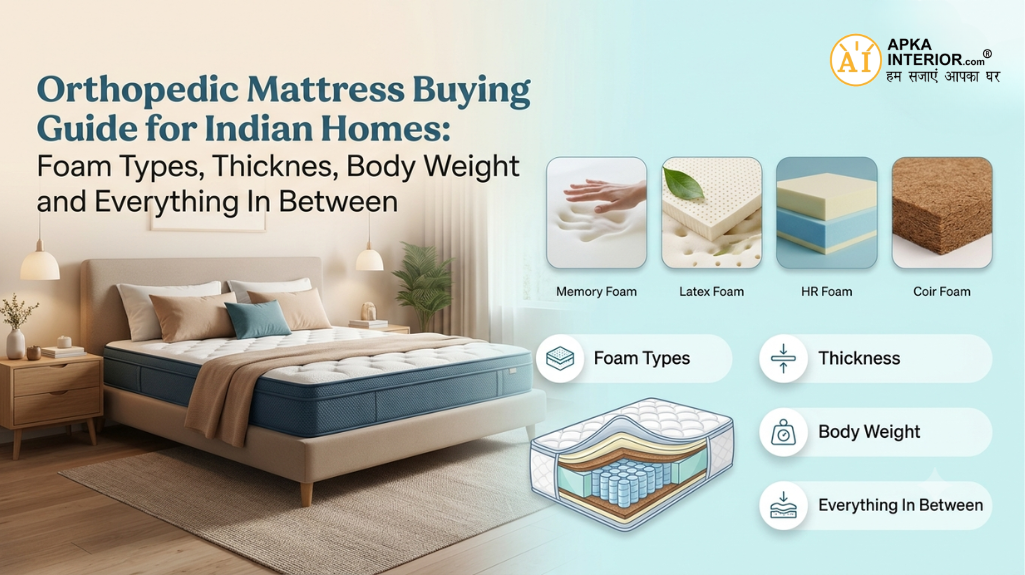
Orthopedic Mattress Buying Guide for Indian Homes: Foam Types, Thickness, Body Weight and Everything In Between
India has a back pain problem. According to health surveys, nearly 60 percent of Indian adults will experience significant back pain at some point in their adult life. Poor posture at work plays a role. Long commutes play a role. But the mattress you sleep on every night? That plays a bigger role than most people realise.
The average Indian spends around seven hours a night on their mattress. Over a year that is more than 2,500 hours. Over the typical lifespan of a mattress, you are looking at roughly 25,000 hours. The surface you sleep on during all of that time shapes your spine, your joints and the quality of rest your body gets.
Yet most Indians spend less than 20 minutes choosing a mattress. They walk into a store, press down on a few options, pick the one that feels soft, and call it done. Softness feels good in the moment but is often the wrong choice for spinal support, especially as we get older.
This guide is going to change how you think about mattress shopping. We will cover every type of mattress sold in India, what foam density numbers actually mean, how thickness affects comfort for different body types, and exactly how to match a mattress to your sleeping position and climate.
Section 1: The Six Types of Mattresses Sold in India
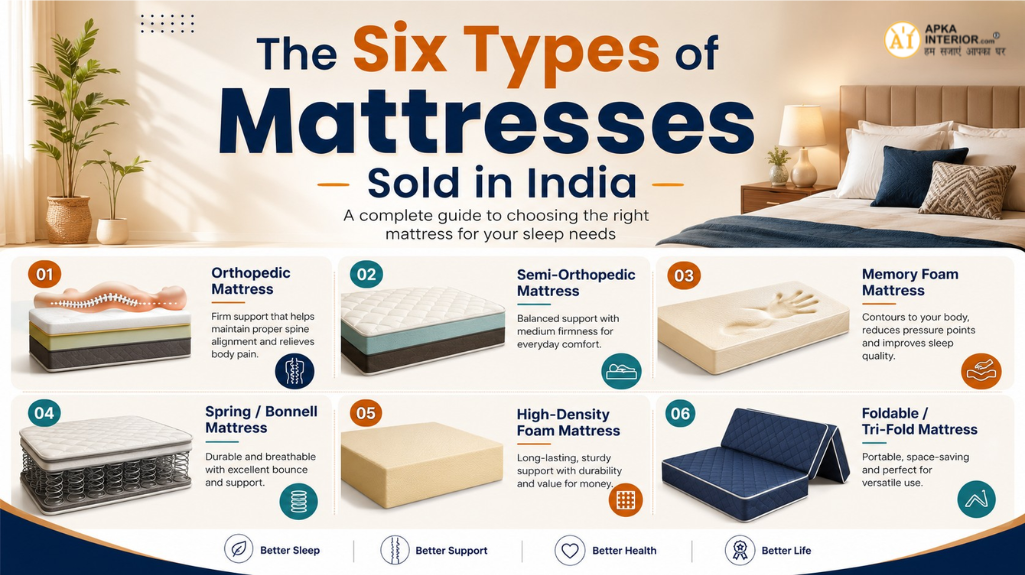
The Indian mattress market has expanded significantly in the last five years. You are no longer choosing between just hard and soft. Here is a breakdown of every major type available and what each one is actually suited for.
1. Orthopedic Mattress
The orthopedic mattress is designed specifically to support the spine and joints. It has a firm base layer that prevents the body from sinking in unevenly, which is what causes pressure points and the morning back stiffness many people wake up with.
Contrary to what many buyers think, orthopedic does not mean hard and uncomfortable. A good orthopedic mattress has firm support at the base with a softer comfort layer on top. You get the support your spine needs and enough surface softness for comfortable sleep. This is the most recommended mattress for people with existing back pain, people over 35 and anyone who sleeps on their back.
2. Semi-Orthopedic Mattress
A semi-orthopedic mattress sits between a regular foam mattress and a full orthopedic one. It offers moderate support, which makes it a good option for younger buyers, those without existing joint issues or anyone who finds a full orthopedic mattress too firm. It is one of the most popular choices in the mid-price segment across Indian cities.
3. Memory Foam Mattress
Memory foam mattress conforms to the shape of your body. It distributes weight evenly and reduces pressure on hips, shoulders and joints. When you get up, it slowly returns to its original shape. That response is what makes it feel luxurious.
The challenge with memory foam in India is heat retention. Memory foam traps body heat, which can make it uncomfortably warm during Indian summers, especially in rooms without air conditioning. Newer gel-infused memory foam variants address this problem to an extent, but breathability remains a consideration. Memory foam works best in air-conditioned bedrooms.
4. Spring or Bonnell Coil Mattress
Spring mattresses use a system of steel coils as their core support structure. They are bouncy, breathable and cool to sleep on because air flows freely through the coil structure. They work well for people who sleep hot or in warmer climates without AC.
The downside is motion transfer. If one person on the bed moves, the springs transmit that movement across the mattress. This makes them a poor choice for couples with different sleep schedules. Pocket spring mattresses (where each coil is individually wrapped) solve this problem but come at a higher price.
5. High-Density (HD) Foam Mattress
High-density foam mattresses are straightforward, durable and cost-effective. The density of the foam is measured in kilograms per cubic metre and directly determines how long the mattress holds its shape. High-density foam does not have the contouring of memory foam or the firm structure of an orthopedic mattress, but it offers reliable everyday comfort at an accessible price point.
HD foam is the most widely used mattress type in Indian households across all income segments. The quality varies significantly based on density, which we will explain in the next section.
6. Foldable or Tri-Fold Mattress
Foldable mattresses are designed for flexibility. They fold into thirds, which makes them easy to store under a bed, carry to another room or set up quickly for a guest. They are not a primary sleeping surface for daily use. Think of them as a guest night solution, a floor sleeping option for children or a camping and travel mattress.
| Mattress Type | Best For | Back Support | Heat Retention | Price Range |
| Orthopedic | Back pain, adults 35 plus, back sleepers | Excellent | Low | Mid to premium |
| Semi-Orthopedic | Young adults, moderate support needs | Good | Low | Budget to mid |
| Memory Foam | Pressure relief, AC rooms, side sleepers | Very good | High | Mid to premium |
| Spring / Bonnell | Hot sleepers, couples (pocket spring) | Moderate | Very low | Budget to mid |
| HD Foam | Everyday use, budget-conscious buyers | Moderate | Moderate | Budget |
| Foldable / Tri-fold | Guests, floor sleeping, travel | Basic | Low | Budget |
Section 2: Foam Density Explained for Indian Buyers
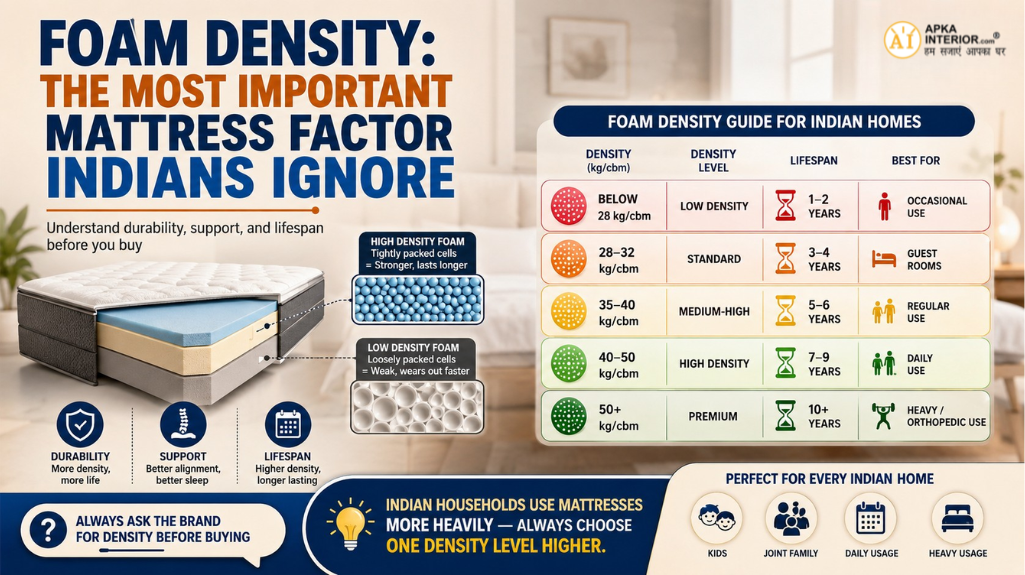
Foam density is the single most important specification to check when buying any foam-based mattress in India and it is also the most ignored. Density tells you how much material is packed into the foam per cubic metre. More material means more durability, better support and longer life.
Density is measured in kilograms per cubic metre (kg/cbm). Here is what the numbers mean in practical terms for an Indian household:
| Foam Density | Classification | Expected Lifespan | Best Suited For |
| Below 28 kg/cbm | Low density | 1 to 2 years | Very occasional use only |
| 28 to 32 kg/cbm | Standard | 3 to 4 years | Guest rooms, light use |
| 35 to 40 kg/cbm | Medium-high | 5 to 6 years | Regular family use |
| 40 to 50 kg/cbm | High density | 7 to 9 years | Daily use, primary bedroom |
| 50 kg/cbm plus | Premium density | 10 years plus | Heavy users, orthopedic needs |
| Why density matters more in India Indian households typically have higher furniture usage than Western averages. Joint family living, children jumping on beds and longer daily use hours mean Indian mattresses face more stress. A mattress rated for 5 years in a European single-occupant home may last only 3 years in a busy Indian household. Always go one density tier higher than you think you need. |
One important note: density figures are not always printed on product labels or listed on e-commerce pages. If you cannot find the density of a mattress you are considering, ask the brand directly before buying. Any reputable mattress brand will share this specification on request.
Section 3: Mattress Thickness Guide for Indian Homes
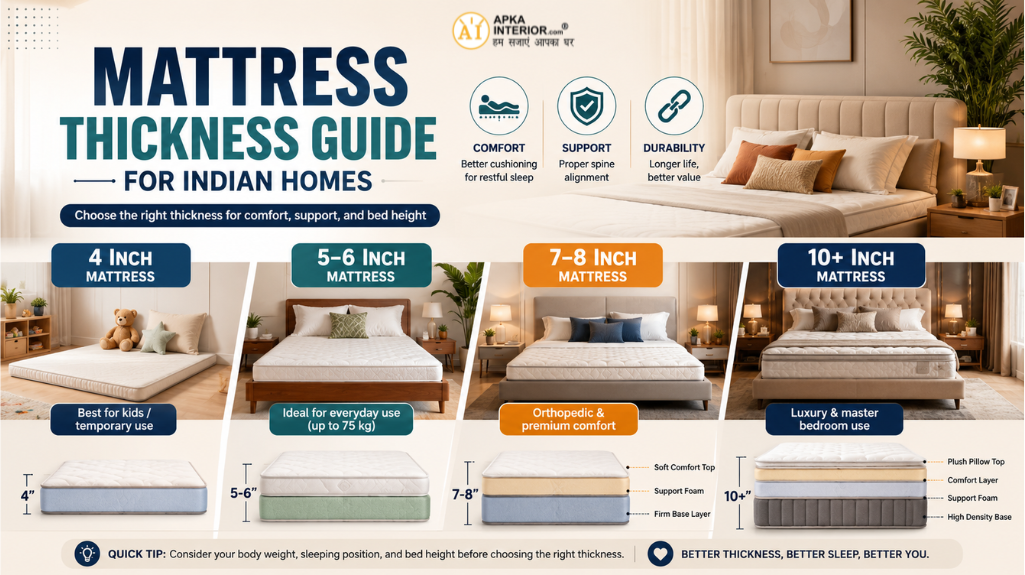
Thickness affects how a mattress feels underfoot when you sit on the bed edge, how easy it is to get in and out of bed and whether it is compatible with your bed frame height. Here is a practical breakdown of thickness options commonly available in India.
4 inch mattress
Four-inch mattresses are thin and are best reserved for children’s beds, trundles, bunk beds and floor sleeping. They do not provide adequate support for adult weight over a full night of sleep. If someone is using a 4-inch mattress as their primary sleeping surface, they will likely feel the floor beneath them within a year.
5 to 6 inch mattress
This is the standard range for most Indian single and double beds. A 6-inch mattress with medium-high density foam (35 to 40 kg/cbm) is a solid everyday choice for adults up to 75 kg in body weight. It works well for most Indian bed frames and keeps the overall bed height comfortable.
7 to 8 inch mattress
The 8-inch range is where you start getting into proper orthopedic and premium mattress territory. These mattresses can have a dual-layer structure: a firm orthopedic base layer with a softer comfort layer on top. They are recommended for adults above 75 kg, people with back or joint issues and anyone who wants hotel-quality sleep comfort at home.
10 inch and above
Premium segment mattresses in the 10-inch-plus category often use a combination of foam types, such as a high-density foam base, a memory foam comfort layer and a soft pillow-top surface. These are ideal for platform beds or beds with low-profile frames, as the mattress itself adds significant height. King and queen-size beds in master bedrooms are the most common use case.
| Thickness | Recommended For | Body Weight | Best Mattress Type |
| 4 inch | Children, bunk beds, floor sleeping | Up to 50 kg | HD foam, foldable |
| 5 to 6 inch | Single adults, regular double beds | 50 to 75 kg | Semi-orthopedic, HD foam |
| 7 to 8 inch | Adults, couples, back pain users | 75 to 100 kg | Orthopedic, memory foam |
| 10 inch plus | Premium setup, platform beds, king size | Any body weight | Orthopedic plus memory foam |
Section 4: Body Type and Sleeping Position Matrix
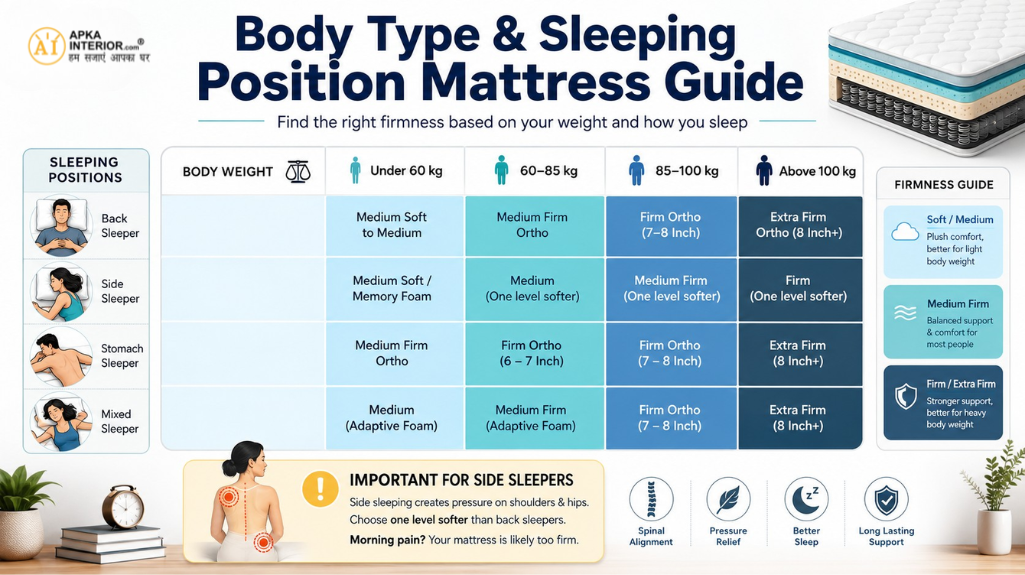
This is the section that makes the most difference to most buyers and the one that is almost never covered in Indian mattress marketing. Your ideal mattress firmness depends on two things: how much you weigh and how you sleep.
| Sleeping Position | Under 60 kg | 60 to 85 kg | 85 to 100 kg | Above 100 kg |
| Back sleeper | Medium firm orthopedic | Firm orthopedic | Firm orthopedic 8 inch | Extra firm, 8 to 10 inch orthopedic |
| Side sleeper | Medium memory foam | Medium orthopedic | Firm ortho with soft top | Firm ortho 8 inch, pocket spring |
| Stomach sleep | Medium to firm HD foam | Medium firm HD foam | Firm ortho | Very firm ortho, 8 inch minimum |
| Mixed / varies | Semi-orthopedic | Medium orthopedic | Orthopedic 7 to 8 inch | Firm orthopedic 8 to 10 inch |
| Important note for side sleepers Side sleeping puts more pressure on the shoulder and hip on the lower side. If your mattress is too firm, these pressure points will ache by morning. Side sleepers generally need a mattress one step softer than back sleepers of the same weight. If you sleep on your side and have shoulder or hip discomfort in the morning, the mattress firmness is almost certainly the cause. |
Section 5: The India Climate Factor
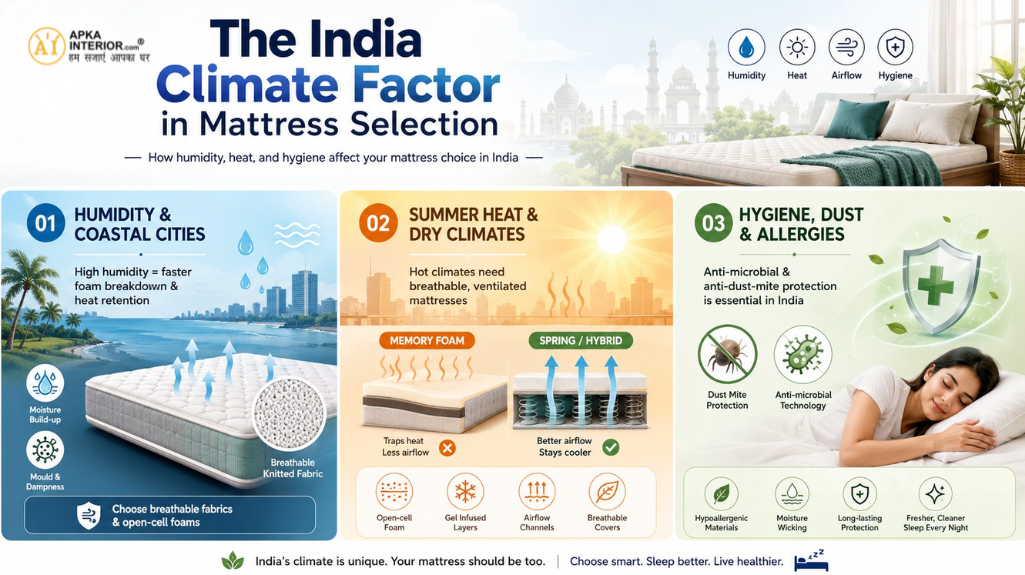
One aspect that global mattress guides completely ignore is how Indian climate conditions affect mattress performance and longevity. India has extreme climate variation across cities and across seasons, and it has a direct impact on which mattress type and which fabric cover performs best for you.
Humidity and coastal cities
If you live in Mumbai, Chennai, Kochi, Vizag or any coastal city, humidity is your biggest mattress enemy. High-moisture environments accelerate the breakdown of foam, promote mould growth inside cheaper mattresses and make memory foam feel heavier and warmer than it already is. For coastal India, look for mattresses with breathable knitted fabric covers rather than thick quilted tops. Anti-microbial treatments on the foam and fabric are a strong plus.
Summer heat and dry climates
For cities like Delhi, Jaipur, Nagpur and Ahmedabad, the summer heat makes memory foam mattresses uncomfortable in rooms without AC. Spring mattresses or well-ventilated HD foam mattresses are more comfortable in high-heat conditions. If you want memory foam in a hot climate, make sure the room has consistent air conditioning and look for open-cell or gel-infused memory foam, which sleeps cooler than standard memory foam.
Anti-microbial and anti-dust-mite treatment
India’s climate makes mattresses more susceptible to dust mites than most countries. Dust mites thrive in warm, humid environments and mattresses are their preferred habitat. Anti-microbial and anti-dust-mite treated mattresses are worth the small premium in India, particularly for anyone with allergies, asthma or skin sensitivities.
Section 6: Mattress Size Guide for Indian Bed Frames
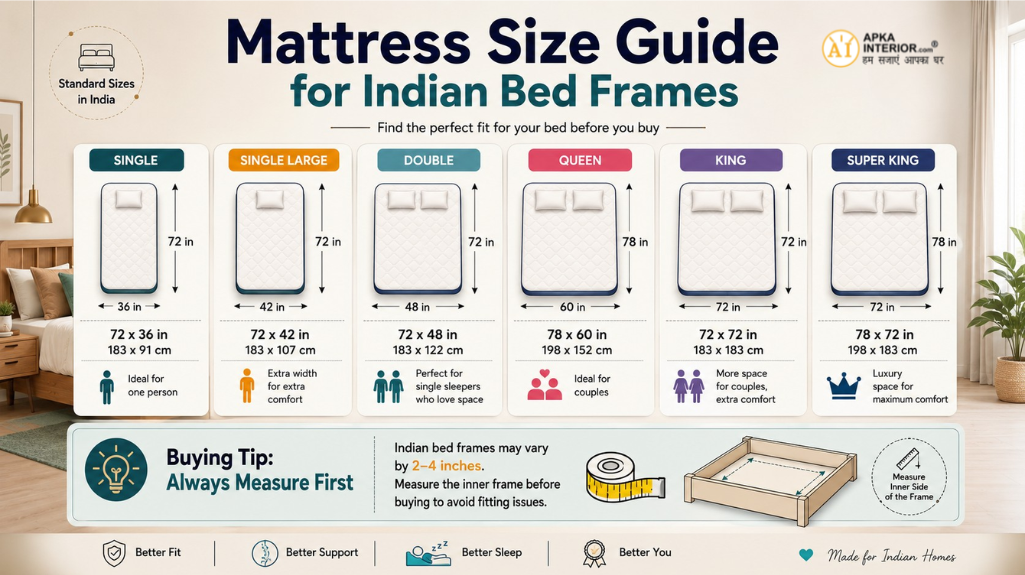
Indian bed frames and mattress sizes follow a slightly different standard than European or American sizing. Before buying a mattress, always measure your existing bed frame or check the specifications of the bed you are buying. Here are the standard mattress sizes available in India:
| Mattress Size | Dimensions (inches) | Dimensions (cm) | Best For |
| Single | 72 x 36 | 183 x 91 | One adult, children, studio flat |
| Single (large) | 72 x 42 | 183 x 107 | Tall adults sleeping alone |
| Double | 72 x 48 | 183 x 122 | Couples in smaller rooms |
| Queen | 78 x 60 | 198 x 152 | Couples, master bedroom standard |
| King | 72 x 72 | 183 x 183 | Couples wanting maximum space |
| Super King | 78 x 72 | 198 x 183 | Luxury master bedrooms |
| Buying tip: Always measure first Never order a mattress based on what size you think your bed frame is. Indian bed frame sizes are not always standardised and there can be a 2 to 4 inch variation between brands. Measure the inner dimensions of your bed frame before ordering. A mattress that is even slightly too large will not sit flat and one that is slightly too small will slide around. |
Frequently Asked Questions About Mattresses in India
Is an orthopedic mattress good for everyone?
Orthopedic mattresses are the best choice for most adults, particularly anyone above the age of 30, back and stomach sleepers and people with existing back or joint issues. They may feel too firm for lightweight individuals or very young children. For children below 10 years, a semi-orthopedic or medium-firm HD foam mattress is usually more comfortable.
Which mattress is best for back pain in India?
For back pain, a firm or medium-firm orthopedic mattress in the 7 to 8 inch thickness range is the most recommended. The mattress should support the natural curve of your lower back without allowing the hips to sink in too deeply. If your current mattress is creating a visible dip or crater where you sleep, it is past its useful life and the dip itself is contributing to your back pain.
How long does a mattress last in India?
With good foam density (35 kg/cbm and above) and regular care, a mattress should last 6 to 8 years in a standard Indian household. Signs it needs replacement include visible dips or sags, waking up with stiffness that was not there when you bought the mattress and the mattress feeling noticeably firmer around the edges than in the centre. Do not wait until the mattress is unusable before replacing it as the deterioration in support happens gradually.
What is the difference between orthopedic and memory foam?
An orthopedic mattress provides firm, consistent support across the entire surface with minimal contouring. Memory foam conforms to your specific body shape, distributing weight very evenly across the surface. Memory foam is excellent for pressure relief and side sleepers with joint issues. Orthopedic foam is better for spinal alignment and back sleepers. Some premium mattresses combine both, with an orthopedic base layer and a memory foam comfort layer on top.
Can I use any mattress size on my existing bed frame?
No, and this is one of the most common and costly mistakes Indian buyers make when shopping online. Mattress dimensions must match the inner dimensions of your bed frame precisely. A mattress even 2 inches larger than the frame will not sit flush and creates a ridge along the sides. Measure your bed frame carefully before ordering. When in doubt, opt for a bed and mattress combination from the same retailer to guarantee compatibility.
Is memory foam good for Indian summers?
Standard memory foam retains heat, which makes it uncomfortable in summer months unless the room has air conditioning running through the night. If you want the benefits of memory foam but live in a warm climate, look for gel-infused memory foam or open-cell memory foam, both of which sleep cooler. Alternatively, pair a memory foam mattress with a breathable cotton mattress cover rather than the polyester ones many mattresses come with.
Find the Right Mattress for Your Home at Apka Interior
You spend a third of your life on your mattress. Getting it right is one of the most practical home decisions you will ever make. At Apka Interior, the mattress range covers everything from budget-friendly semi-orthopedic options to premium orthopedic mattresses built for daily use across Indian conditions.
Browse the complete Bedsheets and Mattress collection to find options across all types and sizes. If you are setting up a new bedroom, explore our Bed range to find frames that are sized to match standard Indian mattress dimensions perfectly. Complete your sleep setup with our Bedsheets and Covers range, with breathable cotton and anti-microbial fabric options suited to every Indian season.