
Kitchen Accessories You Actually Need: The Complete Indian Modular Kitchen Organiser Guide
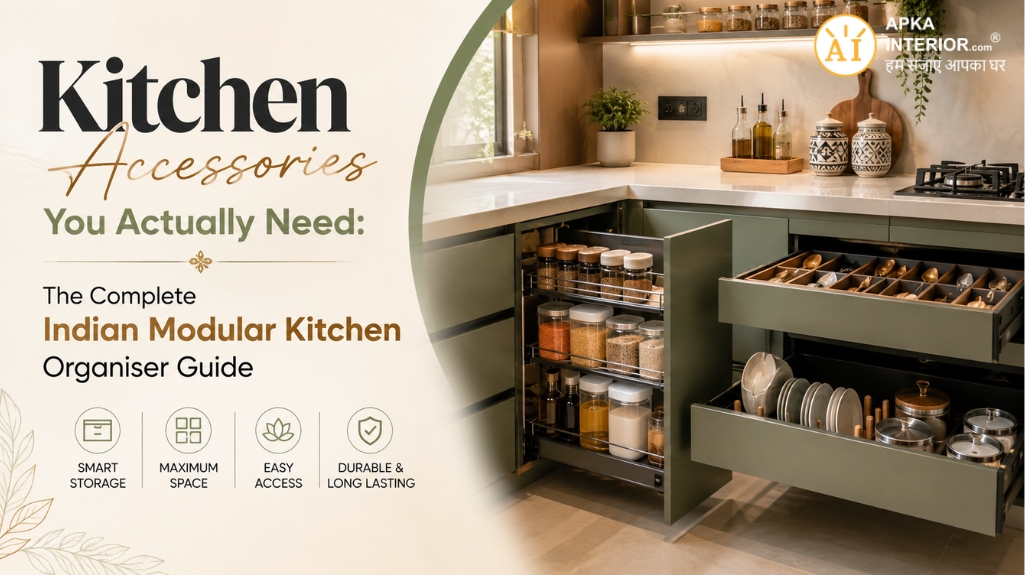
You moved into a brand new apartment with a modular kitchen. Four base cabinets, two wall cabinets, a platform that looks beautiful in the morning light. Six months later the countertop is covered in things that have nowhere to go, the cabinet under the sink is a graveyard of things you forgot you owned and you spend more time looking for things than actually cooking.
This is not a storage problem. It is an accessories problem. A modular kitchen without the right internal accessories is just expensive plywood with doors. The accessories, the carousels, pull-outs, baskets, racks, bin holders and organisers, are what turn cabinet space into functional, usable storage. They are what make the difference between a kitchen you enjoy working in and one that frustrates you every single day.
India’s modular kitchen accessory market has grown substantially over the last five years and the number of options available can be genuinely overwhelming. This guide cuts through the confusion. We will cover every major accessory category, what each one does, which ones solve the most common Indian kitchen problems and what to look for in terms of material, size and quality.
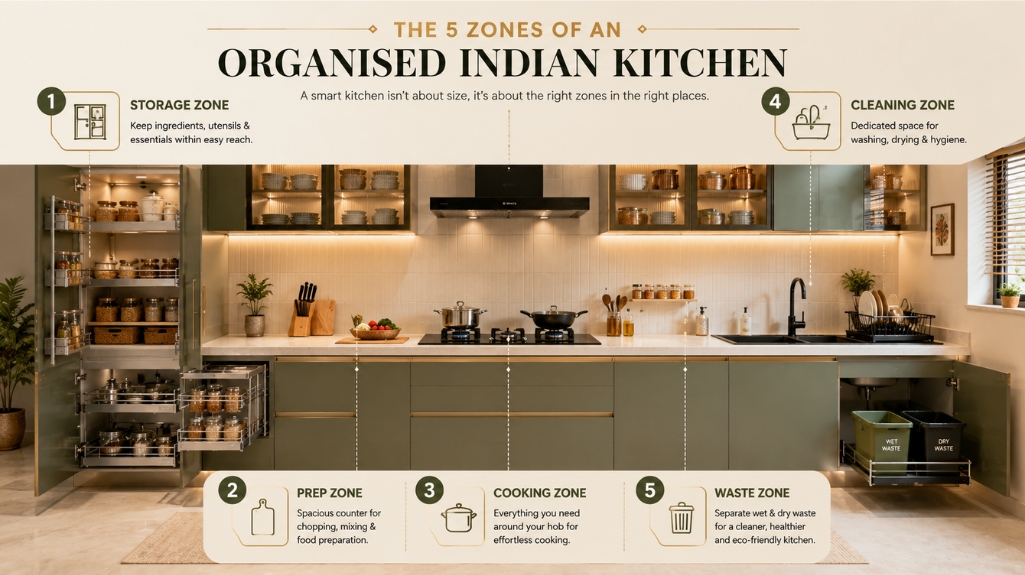
Section 1: The Five Zones of an Organised Indian Kitchen
Before choosing any accessories, it helps to think about your kitchen not as a collection of cabinets but as five distinct functional zones. Every accessory you buy should serve one of these zones clearly. If you cannot immediately answer which zone a product belongs to, you probably do not need it.
| Zone | Function | Primary Location | Key Accessories |
| Storage zone | Dry goods, utensils, pots, pans | Lower base cabinets, pantry units | Carousels, pull-out baskets, plate holders |
| Prep zone | Chopping, mixing, pre-cooking tasks | Counter near the sink | Anti-skid mats, knife blocks, chopping boards |
| Cooking zone | Active cooking, stovetop and oven use | Around the hob and oven | Chimney, pan holders, spice pull-outs |
| Cleaning zone | Washing, drying, waste disposal | Sink cabinet and immediate area | Dishrack, bin holder, liquid soap holder |
| Waste zone | Dustbin, recycling, organic waste | Under-sink or near cooking platform | Bin holder, door-mount waste bags |
| The most important zone to get right first Most Indian kitchen clutter originates in the cleaning zone. The area under the sink is typically the most disorganised space in any Indian modular kitchen. Getting a proper bin holder, a liquid soap organiser and a pull-out dishrack for this one cabinet makes the entire kitchen feel more controlled. Start here before buying anything else. |
Section 2: Carousels and Corner Solutions
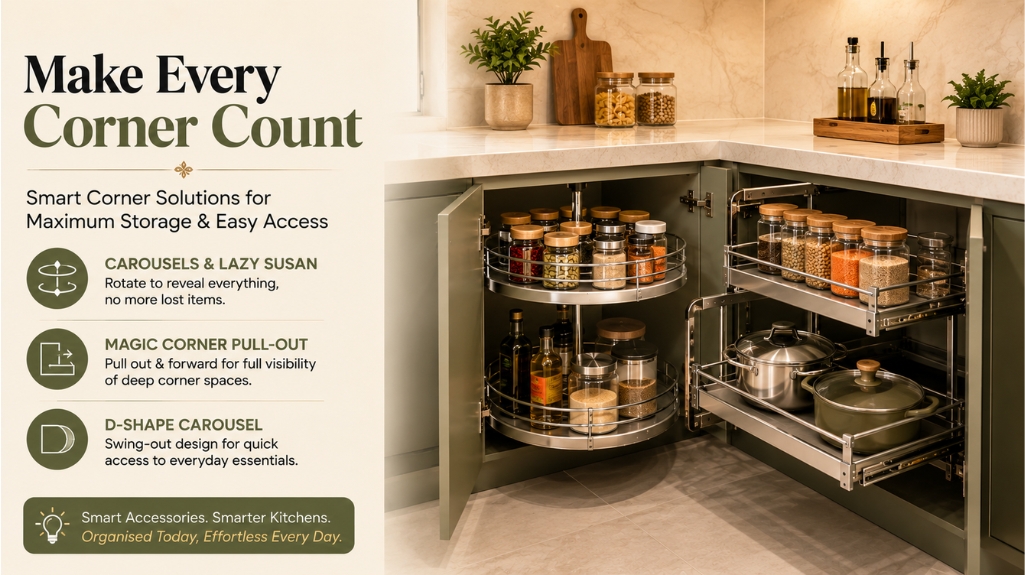
Corner cabinets are the most wasted space in any modular kitchen. A standard L-shaped kitchen has at least one corner cabinet that is deep, dark and practically inaccessible without crouching and reaching blindly to the back. Carousels solve this problem completely.
Full circle carousel (Susan)
A full circle carousel, also commonly called a lazy Susan, consists of two circular rotating trays stacked vertically inside the corner cabinet. You spin the trays to bring whatever you need to the front. This works best in corner cabinets that have a hinged door opening on both sides of the corner.
For Indian kitchens, the full circle carousel is excellent for storing oils, vinegars, dry spices and frequently used condiments. The rotating mechanism means nothing is ever truly inaccessible. Look for carousels with a rim or edge raised slightly to prevent bottles from sliding off when the tray rotates.
Half circle carousel (D-shaped)
A D-shaped or half-circle carousel is attached to the cabinet door and swings out when the door opens, bringing the stored items with it. This design is often more practical than the full circle variant because it maximises the usable depth of the corner cabinet more efficiently. The D-shape also prevents items from getting stuck at the back.
D-shaped carousels are particularly popular in Indian kitchens because Indian cooking involves a large number of small bottles and containers, and the swinging-out mechanism makes all of them visible and accessible in one motion.
Magic corner pull-out
The magic corner is a more premium accessory that uses a folding arm mechanism. When you pull the inner tray out, a second tray at the back automatically swings forward, making the full depth of the corner cabinet accessible without any reaching or crouching. This is the most expensive corner solution but also the most functional. For buyers who cook daily and use the corner cabinet for everyday items, the magic corner is worth the investment.
| Sizing tip for corner carousels Before buying any corner carousel, measure the inside width of your corner cabinet opening at both the door frame and the back wall. Corner cabinets in Indian modular kitchens vary between 80 and 100 centimetres per side. The carousel diameter must be smaller than the narrowest internal measurement. Most standard carousels are sized at 60, 70 or 80 centimetres and the product listing will specify which cabinet size they fit. |
| Carousel Type | Best For | Cabinet Type | Price Range |
| Full circle (Susan) | Spices, condiments, regular access items | Corner with two-sided door | Budget to mid |
| Half circle (D-shape) | Small bottles, daily-use items | Corner with single door | Mid |
| Magic corner pull-out | Full corner utilisation, daily cooking | Any corner cabinet | Mid to premium |
| Plain rotating tray | Base or wall cabinets (non-corner) | Any standard cabinet | Budget |
Section 3: Pull-Out Baskets, Plate Holders and Pantry Units
Pull-out baskets transform deep base cabinets from dark, inaccessible storage into fully visible, easy-to-reach organised space. This is one of the highest-impact accessory categories in any modular kitchen and also one of the most widely misunderstood in terms of sizing.
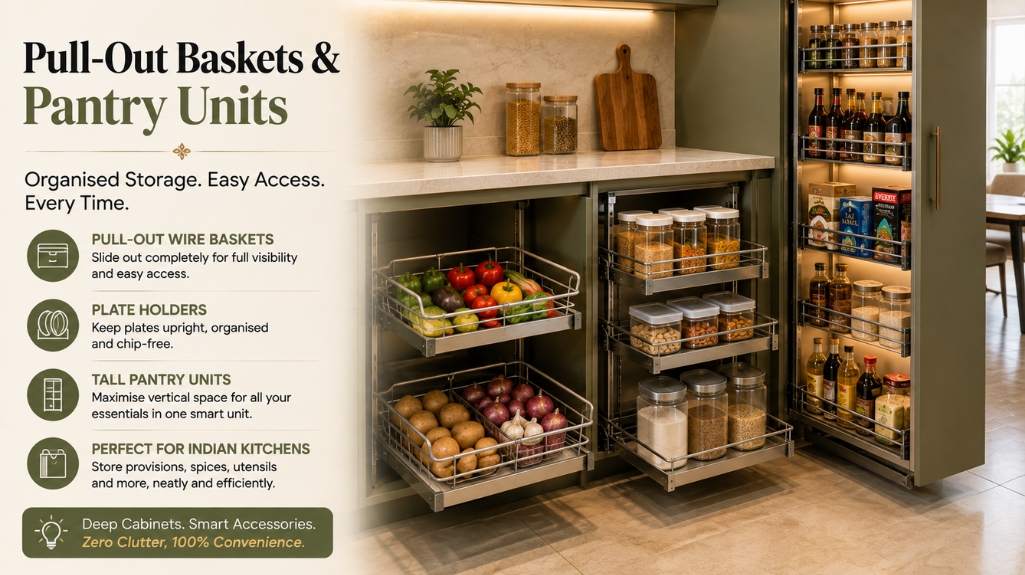
Pull-out wire baskets
Wire baskets slide in and out of the cabinet on rails, bringing the full contents of the cabinet to the front in one motion. They are available as single baskets or in stacked sets of two or three baskets per cabinet. Stacked pull-out sets are particularly useful for storing vegetables, fruits, provisions and dry goods in a way that lets you see everything at a glance without removing other items to reach the one you want.
For Indian kitchens, stainless steel wire baskets are the most practical choice because they do not rust, handle the oils and moisture that inevitably accumulate in an Indian kitchen environment and can be wiped clean quickly. Chrome-plated steel is slightly less resistant to the high-humidity and high-heat environment of Indian cooking over time and may show corrosion at the plating edges after a few years.
Plate holders and dish organisers
Vertical plate holders that slot into a drawer or a pull-out unit keep plates organised and easy to retrieve without stacking. Horizontal stacking of heavy plates in Indian kitchens is one of the most common sources of chipped crockery and injured wrists. A vertical plate organiser that keeps six to eight plates in individual slots prevents both problems. These are available in wire and in plastic-coated versions. The plastic-coated type is gentler on fine crockery and the better choice for households with bone china or ceramic plates.
Tall pantry pull-out units
A tall pantry pull-out is a full-height cabinet accessory that converts a tall tower cabinet (typically 200 centimetres high and 30 centimetres deep) into a highly organised pantry with multiple pull-out shelves of different depths. These units are the most space-efficient storage solution available for any modular kitchen and are particularly valuable in smaller Indian apartments where kitchen floor space is limited.
A well-specified tall pantry unit can store three months of dry provisions, spices, oils and cleaning supplies in a single 30-centimetre-wide cabinet with complete visibility and accessibility. If you are planning a modular kitchen from scratch, allocating one tower cabinet for a tall pantry pull-out is one of the best decisions you can make.
| Critical measurement before buying any pull-out basket Internal cabinet width and the rail system matter more than external cabinet size. The internal width of a standard Indian modular kitchen base cabinet is typically 45, 60 or 90 centimetres. The pull-out basket must match the internal width precisely, not the external cabinet width. Measure from the inside edge of the cabinet carcass on both sides. A basket that is even 2 centimetres too wide will not fit on the rails and cannot be returned easily once purchased. |
Section 4: Bin Holders, Dishracks and the Cleaning Zone
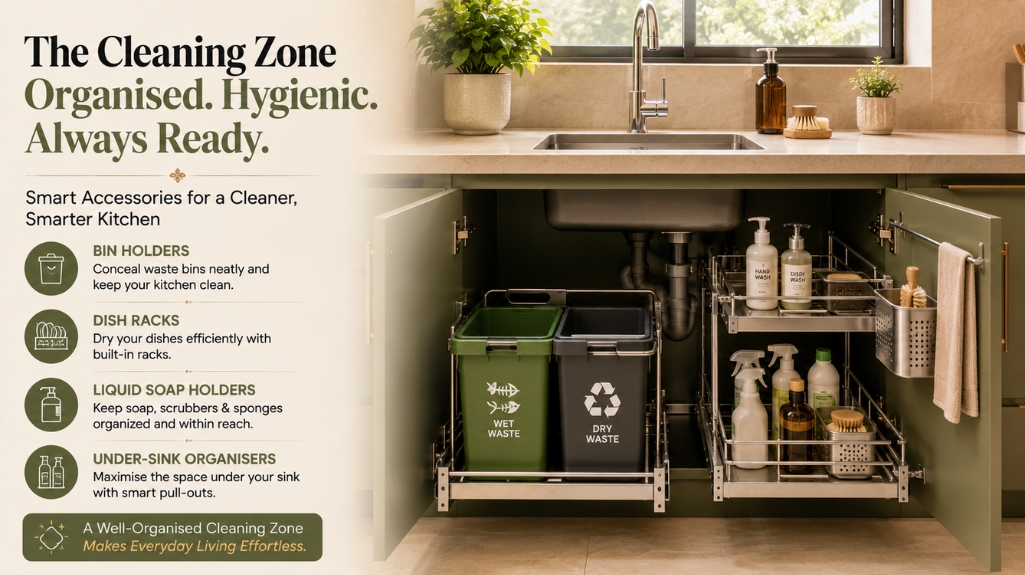
The under-sink cabinet is universally the most chaotic space in the Indian kitchen. It has awkward depth, it has a plumbing pipe running through the middle of it and it typically becomes a place where cleaning products, spare sponges, dustbin bags and random items accumulate without any organisation system.
Three accessories transform this space completely.
Bin holders
A bin holder is a pull-out frame that mounts inside the under-sink cabinet and holds one or two bins that slide in and out with the door. This removes the loose dustbin from the floor entirely, creates a designated and accessible waste zone and makes the cleaning zone feel immediately more organised.
For Indian kitchens where wet waste is separated from dry waste, a dual-bin holder with two compartments is highly practical. One bin for wet organic waste, one for dry recyclables. The bins in the holder should be removable for emptying and cleaning because the organic waste in Indian kitchens requires frequent bin washing.
Look for a bin holder whose frame height is compatible with your under-sink cabinet height. The plumbing pipe running through the cabinet affects the maximum frame height that will fit. Measure the clear height on both sides of the pipe before purchasing.
Dishracks and draining boards
The dishrack is one of the most personal accessories in an Indian kitchen because Indian households vary enormously in how much crockery and cookware they wash daily. A family of four cooking Indian food three times a day generates a very different dishwashing volume than a couple who eats out frequently.
The two main dishrack types for Indian kitchens are counter-top dishracks and under-counter pull-out dishracks. Counter-top dishracks are placed on the kitchen platform near the sink. They are accessible and practical but they occupy valuable platform space. Pull-out dishracks mount inside the cabinet above the sink and slide out for loading and back in after drying. They keep the platform clear but require the cabinet above the sink to be configured appropriately.
For Indian cooking volumes, a dishrack with separate compartments for plates, glasses, bowls and utensils is more practical than a single open-wire rack because it keeps different types of crockery from getting mixed and reduces the chance of breakage. Stainless steel is the most hygienic and durable material for Indian dishracks and holds up to the steam and moisture exposure of an Indian kitchen environment far better than plastic or chrome-plated variants.
Liquid soap and scrubber holders
A mounted liquid soap dispenser and a holder for scrubbers, sponges and cleaning brushes at the sink area is a small but high-impact accessory. It removes these items from the counter surface, keeps them organised and makes the sink area feel clean and deliberate rather than cluttered.
Wall-mounted or sink-rail mounted versions that do not require drilling into the kitchen tiles are the most practical choice for renters and for buyers who want flexibility to rearrange. Adhesive-mounted holders work in dry conditions but tend to detach over time in the high-humidity environment directly beside the sink. Rail-mounted systems that clip onto the sink rim are the most reliable option.
Section 5: Material Guide for Kitchen Accessories in India
Indian cooking is significantly more demanding on kitchen accessories than most other cuisines in the world. High-flame cooking, heavy oil usage, steam from pressure cookers, turmeric and masala stains, and the volume of daily cooking all affect how long an accessory lasts and how easy it is to clean. Here is an honest material comparison.
| Material | Rust Resistance | Heat Resistance | Stain Resistance | Ease of Cleaning | Durability | Best For |
| 304 Grade SS | Excellent | Excellent | Very good | Very easy | 10 plus years | All kitchen accessories, primary choice |
| 202 Grade SS | Good | Good | Good | Easy | 5 to 7 years | Budget kitchens, lighter use |
| Chrome plated | Moderate | Good | Moderate | Easy when new | 3 to 5 years | Dry storage zones only |
| Powder coated | Good | Moderate | Good | Easy | 4 to 6 years | Baskets, shelves in dry zones |
| Aluminium | Excellent | Good | Moderate | Easy | 7 to 9 years | Pull-outs, frames, rails |
| ABS Plastic | N/A | Low | Low | Very easy | 3 to 5 years | Bin holders, non-heat zones only |
| The grade of stainless steel matters more than you think Not all stainless steel kitchen accessories are equal. 304 grade stainless steel contains 18 percent chromium and 8 percent nickel, which gives it genuine rust resistance even in the high-humidity, high-steam environment of Indian cooking. 202 grade is lower cost but has reduced nickel content and will show rust at weld points and scratches in humid conditions within a few years. When buying any stainless steel kitchen accessory, ask specifically for 304 grade. For the price difference (typically 15 to 25 percent), the lifespan difference is substantial. |
Section 6: Chimney Selection for Indian Cooking
A chimney is arguably the most important kitchen accessory in an Indian home. Indian cooking, with its daily tadkas, frying, deep-dish curries and high-flame cooking, produces far more smoke, oil particles and steam than most other cooking styles. A kitchen without an effective chimney will have oil-coated walls, sticky cabinets and a cooking area that smells and feels unpleasant to work in within months.
Suction power: the specification that matters most
Chimney suction power is measured in cubic metres per hour (m3/hr). This number tells you how much air the chimney can pull through itself per hour. For Indian cooking, the general recommendation is significantly higher than for Western cooking because of the volume and intensity of fumes produced.
| Kitchen Size | Cooking Frequency | Recommended Suction Power |
| Up to 100 sq ft | Light (1 to 2 times daily) | 400 to 600 m3/hr |
| Up to 100 sq ft | Heavy (3 plus times daily) | 600 to 800 m3/hr |
| 100 to 150 sq ft | Light to moderate | 600 to 800 m3/hr |
| 100 to 150 sq ft | Heavy Indian cooking | 800 to 1000 m3/hr |
| Above 150 sq ft | Any frequency | 1000 to 1200 m3/hr |
| Open kitchen layout | Any frequency | 1200 m3/hr minimum |
Filterless vs baffle filter vs cassette filter
Filterless chimneys use a centrifugal mechanism to separate oil particles from air without a physical filter. They are easier to maintain because there is no filter to clean, but they require the internal parts to be cleaned periodically. They are well-suited to heavy Indian cooking because they do not clog the way filter-based chimneys do.
Baffle filter chimneys use curved metal plates to deflect air and trap oil. The baffles are dishwasher-safe and can be cleaned monthly with warm water and a degreaser. They handle Indian cooking volumes well and are the most popular chimney type for Indian kitchens at a mid-range price.
Cassette filter chimneys use flat mesh filters that trap oil and require cleaning every two weeks in a heavy Indian cooking household. They are effective when maintained but the frequency of cleaning required makes them less practical than baffle or filterless chimneys for most Indian families.
| Auto-clean chimneys for Indian kitchens Auto-clean chimneys have a heating element that periodically heats the collected oil, liquefying it so it drains into a collection cup rather than coating the internal surfaces. In a household that cooks Indian food daily, an auto-clean chimney can save 30 to 60 minutes of deep-cleaning effort per month. The oil collection cup still needs to be emptied and cleaned but this is a 5-minute task compared to a full filter cleaning. For heavy Indian cooking households, auto-clean is worth the premium. |
Section 7: The Indian Modular Kitchen Accessories Checklist
Use this checklist to audit your current kitchen and identify which accessories will solve the most pressing organisation problems in your specific setup.
Must-have accessories for every Indian modular kitchen
- Carousel or lazy Susan for every corner cabinet
- Pull-out basket set for at least two base cabinets (vegetable storage and provision storage)
- Bin holder for the under-sink cabinet (dual compartment for wet and dry waste)
- Dishrack either counter-top or pull-out depending on your cabinet configuration
- Chimney with suction power appropriate to your kitchen size and cooking frequency
- Liquid soap dispenser and scrubber holder at the sink
- Anti-skid mat for the base of deep cabinets to prevent items from sliding and to make cleaning easier
High-impact additions that most buyers overlook
- Plate holder in the cabinet above the dishrack or in a drawer near the dining area
- Tall pantry pull-out if you have a tower cabinet available
- Spice pull-out a narrow pull-out unit beside the hob for frequently used spices during cooking
- Door-mounted shelves thin shelves mounted on the inside of cabinet doors for small bottles, sachets and wraps
- Under-shelf basket clips under an existing shelf to create an additional storage tier without adding any new hardware
Optional accessories worth considering
- Magic corner unit if the corner cabinet is heavily used and the budget allows
- Cutlery organiser tray for the utensil drawer to prevent the jumbled-cutlery problem
- Lid holder a pull-out or rack specifically for storing pot and pan lids vertically rather than stacked
- Vertical dividers for storing baking trays, cutting boards and flat items upright rather than horizontally stacked
Frequently Asked Questions About Modular Kitchen Accessories in India
Which carousel is best for corner cabinets in an Indian kitchen?
For most Indian modular kitchens, the D-shaped half-circle carousel is the most practical corner solution. It swings out fully when the door opens, making every item accessible without reaching. Full-circle Susan carousels work well for storing spices and condiments but lose space at the back of very deep corner cabinets. If the budget allows, a magic corner pull-out is the most functional option of the three as it uses the full depth of the corner cabinet efficiently.
What size chimney do I need for an Indian kitchen?
For a standard Indian apartment kitchen between 80 and 120 square feet with daily cooking, a chimney with 600 to 800 m3/hr suction capacity is the right starting point. If you cook three or more meals a day or regularly make deep-fried items, increase to 800 to 1000 m3/hr. For open-plan kitchen layouts where the kitchen opens into the living or dining area, a minimum of 1200 m3/hr is recommended because the smoke and oil particles have a much larger area to travel through before being captured.
Is stainless steel or aluminium better for kitchen baskets in India?
304 grade stainless steel is the better material for any kitchen basket in an Indian home. It is fully rust-proof, handles the steam, oil and heat of Indian cooking without degradation and can be cleaned with strong degreasers without surface damage. Aluminium is a good lightweight alternative for frames and rails but can show surface oxidation over years in very humid conditions. Chrome-plated steel is adequate for dry storage zones but is not recommended for any area near the sink, hob or dishwashing area because the plating can deteriorate and expose the steel underneath to rust.
How do I organise the under-sink cabinet in a modular kitchen?
The under-sink cabinet needs three things: a bin holder for waste management, a pull-out organiser or simple shelf for cleaning products and a liquid soap and scrubber holder at the sink. The plumbing pipe that runs through this cabinet limits the accessory options, so measure the usable height on both sides of the pipe before buying any pull-out frame. A two-tier bin holder that fits around the pipe is available from most kitchen accessory brands and is designed specifically for this constraint. Keep this cabinet dedicated to cleaning-zone items only and avoid using it as overflow storage for provisions or utensils.
Are pull-out kitchen baskets worth buying in India?
Yes, without qualification. Pull-out baskets are the single highest-impact kitchen accessory for any Indian home. A deep base cabinet without pull-outs typically has around 40 percent of its storage volume genuinely accessible on a daily basis. The rest is out-of-sight, hard-to-reach space that becomes cluttered. The same cabinet with a two-tier pull-out basket makes 100 percent of the storage visible and accessible. The cost of adding pull-outs to two or three key cabinets is usually recovered within months in reduced food waste alone, from provisions that were out of sight and expired before being used.
What is the difference between a dishrack and a pull-out dishrack?
A regular counter-top dishrack sits on the kitchen platform beside the sink and dishes are placed in it to air dry. A pull-out dishrack is mounted inside the wall cabinet directly above the sink on special rails. Dishes are placed in it after washing and the cabinet below catches the dripping water before it evaporates. The pull-out dishrack keeps the platform completely clear, which is a significant advantage in smaller Indian kitchens where counter space is at a premium. It requires the wall cabinet above the sink to be configured specifically for this purpose, ideally planned during the modular kitchen installation rather than retrofitted afterward.
Shop Kitchen Accessories at Apka Interior
Every accessory category covered in this guide is available at Apka Interior. From corner carousels and pull-out baskets to bin holders, dishracks, chimneys and complete kitchen organisation systems, the full range is available online with delivery across India.
Browse our Kitchen Carousel collection for corner solutions across all cabinet sizes. Find the right Bin Holder for your under-sink cabinet in single and dual-compartment options. Shop our Dishrack range in both counter-top and pull-out varieties. Explore our Kitchen Chimney selection with suction capacities from 400 to 1200 m3/hr for every kitchen size. And complete your kitchen organisation with Shelves, Liquid Soap Holders and Anti-Skid Mats designed for Indian kitchen conditions.