
Diwali Home Makeover Guide 2026: How to Make Every Room in Your Home Look Festive Before the First Guest Arrives

There is a specific kind of pressure that settles over Indian households in the weeks before Diwali. The kind where you notice the sofa cushions are flat, the curtains look tired, the entrance feels like it needs something, and the living room that was perfectly adequate in October has somehow become insufficient for November guests.
Diwali is the one time of year when most Indian homeowners step back and actually look at their home the way a visitor would. And what they often see is a space that functions well but does not feel festive, warm or ready for the kind of entertaining and gifting rituals that define the season.
The good news is that transforming a home for Diwali does not require a renovation. It requires a plan. Knowing which rooms to focus on, which decor elements create the most visible impact for the least spend, how to use lighting to change the entire mood of a space, and what to buy first so the home feels complete before the season actually begins.
This guide gives you exactly that plan, room by room, with a full budget breakdown and a festive decor checklist so nothing gets missed.
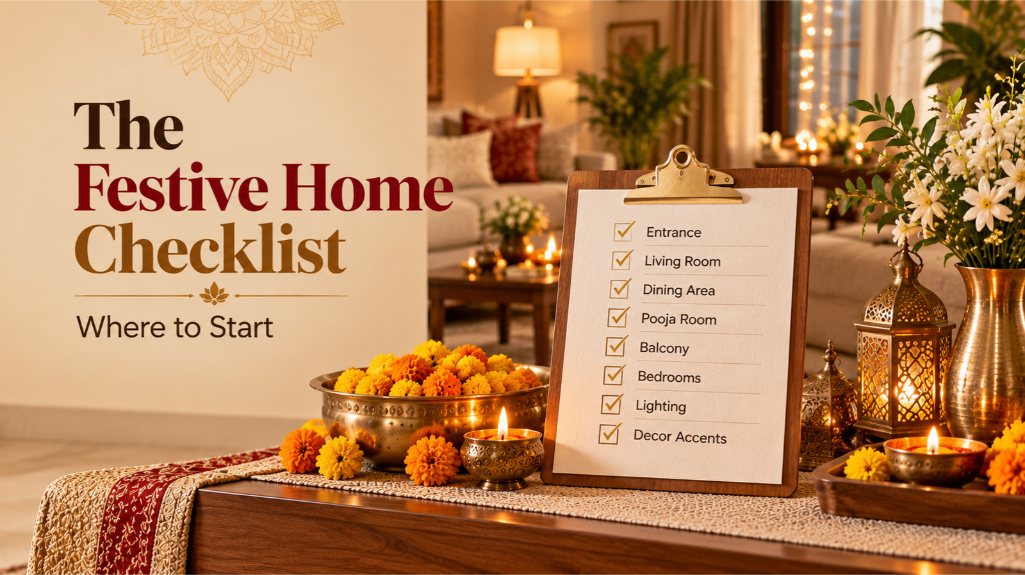
Section 1: The Festive Home Checklist — Where to Start
Before buying anything, walk through your home with fresh eyes and assess each space against three questions: Does this room feel clean and intentional? Does it have enough seating for guests? Does it have any warmth or festive character in its current state? The rooms that fail all three questions are your highest-priority zones. The rooms that need only a finishing layer of decor are your quick wins.
Here is a room-by-room priority framework for a standard Indian 2BHK or 3BHK home in the festive season:
| Room | Festive Priority | Most Impactful Change | Typical Time Needed |
| Entrance | Critical | Torans, diyas, rangoli mat, entrance lamp | 1 to 2 hours |
| Living room | Critical | Cushion refresh, curtain upgrade, accent light | 2 to 4 hours |
| Dining area | High | Table centrepiece, placemats, pendant lighting | 1 to 2 hours |
| Pooja room | High | New diyas, artefacts, brass accessories | 1 to 2 hours |
| Balcony | High | String lights, planters, outdoor seating | 1 to 3 hours |
| Guest bedroom | Moderate | Fresh bedsheet set, curtain, bedside lamp | 1 hour |
| Kitchen | Low | New dish towels, storage jars, anti-skid mat | 30 minutes |
| Bathroom | Low | Fresh towel set, soap dispenser, small plant | 30 minutes |
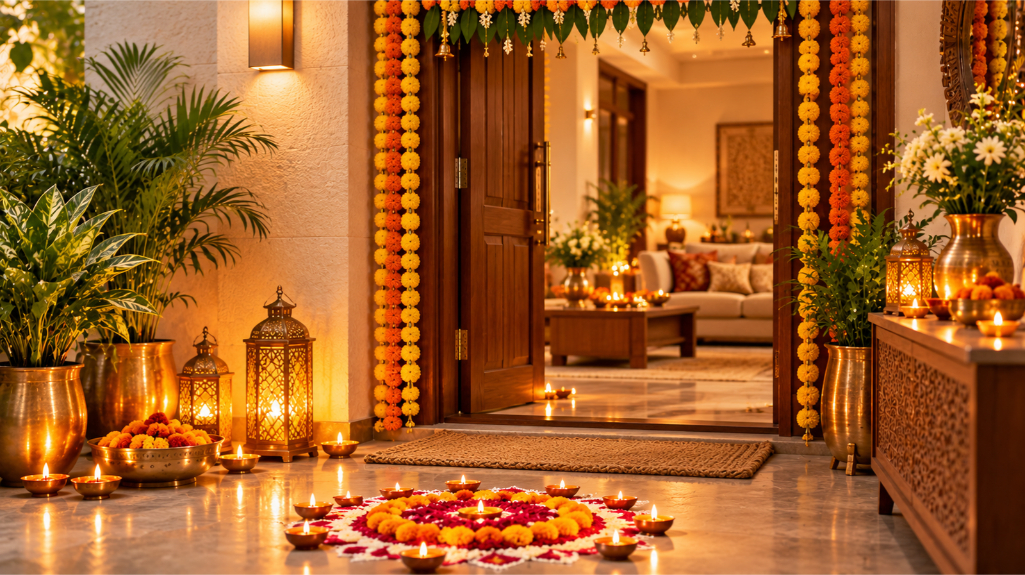
| Start with the entrance, always The entrance is the first impression of everything. In Indian homes during Diwali, the entrance sets the tone for the entire visit. A toran on the door, diyas or a lamp at the threshold, a rangoli or a doormat with a festive pattern, and one statement plant or planter is all it takes to transform a plain apartment entrance into one that announces the season the moment a guest arrives. Spend here first before any other room. |
Section 2: Living Room — The Most Important Room to Get Right
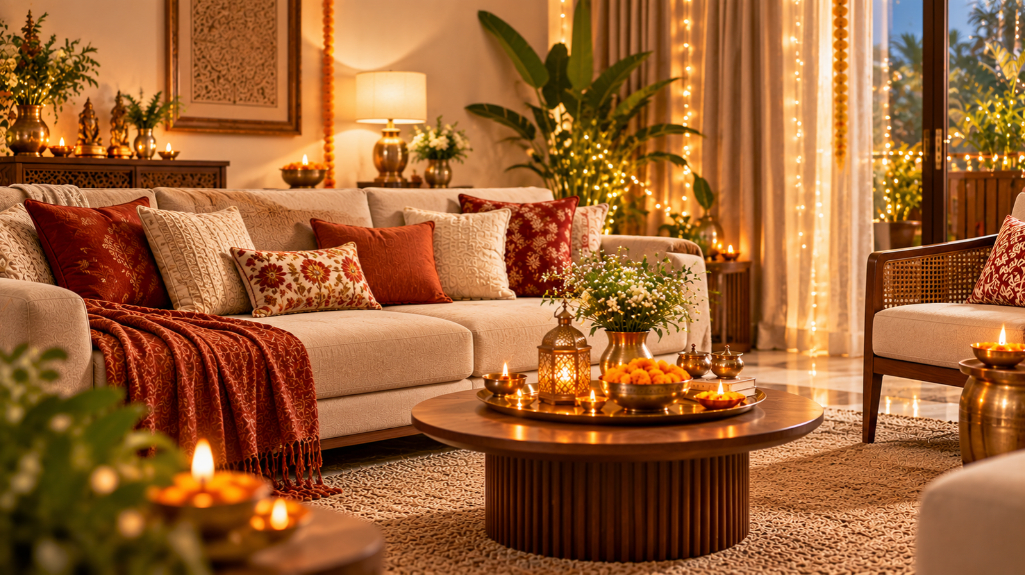
The living room is where guests will spend the most time and where your festive investment will be most visible. The goal is not to add as many decorative items as possible. The goal is to make the room feel warm, full and intentional with a small number of well-chosen additions.
Cushion and textile refresh: the highest-impact, lowest-cost upgrade
Fresh cushion covers are the single fastest way to change how a living room feels. Replacing the existing covers with festive-appropriate colours, warm jewel tones like deep gold, burnt orange, emerald green, ruby red and royal blue, takes twenty minutes and costs between Rs 800 and Rs 2,500 for a set of five covers. The covers do not need to match exactly. A mix of two complementary tones in solid and one printed (ideally with a traditional Indian motif like a block print or ikat pattern) gives the sofa a layered, intentional look.
If the living room rug looks worn or out of place with the festive colour direction, a new flat-weave or low-pile rug in a warm earthy or jewel tone is the next-highest-impact purchase. A rug of 150 by 230 centimetres for a standard 2BHK living room costs Rs 2,500 to Rs 6,000 and transforms the visual base of the seating zone.
Curtain upgrade for the festive season
Curtains occupy more visual real estate in a living room than almost any other element. If the existing curtains are plain white or beige and the room needs a festive lift, replacing them with a deeper, richer tone for the season is one of the most dramatic single changes you can make. Velvet or silk-look polyester curtains in deep teal, burgundy, forest green or dark gold look genuinely festive during the Diwali season and work beautifully in the warm artificial light that dominates festive home gatherings in the evenings.
For buyers who do not want to replace curtains entirely, adding a sheer layer in a warm gold or ivory tone behind the existing curtains costs significantly less and creates a layered, soft look that reads as intentional. Sheer curtains in warm gold tones catch the light beautifully when diyas or warm lamps are lit in the room.
Accent lighting for festive warmth
The living room during Diwali evenings should be lit primarily by warm accent sources rather than a bright central ceiling light. If you have table lamps or a floor lamp in the living room, switch the bulbs to 2700K warm white if they are not already. Add a string of warm LED fairy lights along the top edge of the TV unit or shelves, wound loosely rather than in a neat line for a more organic, festive quality.
Cluster diyas on the centre table surface and on the window sill. Real clay diyas lit with oil give a warmth and a fragrance that no electric substitute matches. Combine them with a few brass tea light holders for a more structured display. The combination of diya light, lamp light and fairy light in a living room during a Diwali evening is genuinely beautiful and costs very little to achieve.
Wall decor for the festive backdrop
If the wall behind the sofa is bare or has a piece that does not suit the festive direction, this is the moment to add something that stays relevant beyond the season. A large framed painting or print in warm tones, a metal wall art piece in brass or copper finish, or a hand-painted traditional work like a Madhubani or Pichwai makes the sofa wall feel anchored and intentional. These pieces serve the room for years after the season, making the spend worthwhile regardless of the festive timing.
Section 3: The Entrance — Your Festive First Impression
In Indian culture, Diwali begins at the door. The entrance of the home is where Lakshmi is welcomed, where guests form their first impression and where the festive spirit either announces itself or fails to show up. Here is how to dress the entrance correctly for the season.
Toran and door decor
A toran is the hanging decoration placed above the main door, traditionally made from mango leaves, flowers or beads. For an apartment entrance, a fabric or beaded toran in marigold yellow, deep orange or gold tones is the most practical choice. It lasts across multiple festive seasons, costs Rs 200 to Rs 800 and takes two minutes to hang. The toran signals the season instantly and is the single most culturally recognisable festive entrance element in Indian homes.
Below the toran, the door itself can have a rangoli design painted or stickered on the lower panels. Dry rangoli colours in traditional patterns applied directly to the door or around the threshold are traditional in many Indian households. For apartment buildings where permanent rangoli is not practical, rangoli door mats with printed festive designs are a clean, maintenance-free alternative.
Diyas, lamps and threshold lighting
A pair of brass or terracotta lamps placed on either side of the entrance, lit with ghee or oil, is the most traditional Diwali entrance decoration and also one of the most visually powerful. For apartments where floor space at the entrance is limited, wall-mounted lamp holders or a single statement lamp on a console or shoe cabinet beside the door work equally well.
String lights along the door frame or wound around a potted plant at the entrance add a contemporary, warm festive quality without requiring any permanent installation. Warm white or golden yellow LED string lights at 2700K are the most appropriate colour for festive entrance lighting. Avoid cool white or multicolour string lights at the entrance: they look more commercial than festive in an Indian home context.
Planter and entrance greenery
A well-chosen plant in a decorative planter at the entrance is one of the highest-impact entrance upgrades regardless of the season. For Diwali specifically, a marigold plant in a brass or terracotta planter is a traditional and beautiful choice. Marigold is the flower of the festive season in India and its deep orange and yellow tones are perfectly calibrated to the Diwali colour palette. A planter of 25 to 35 centimetres in a patinated brass or hand-painted terracotta finish holds a marigold plant beautifully and doubles as a permanent entrance planter through the rest of the year with different seasonal plants.
Section 4: The Pooja Room — Dressing the Sacred Space
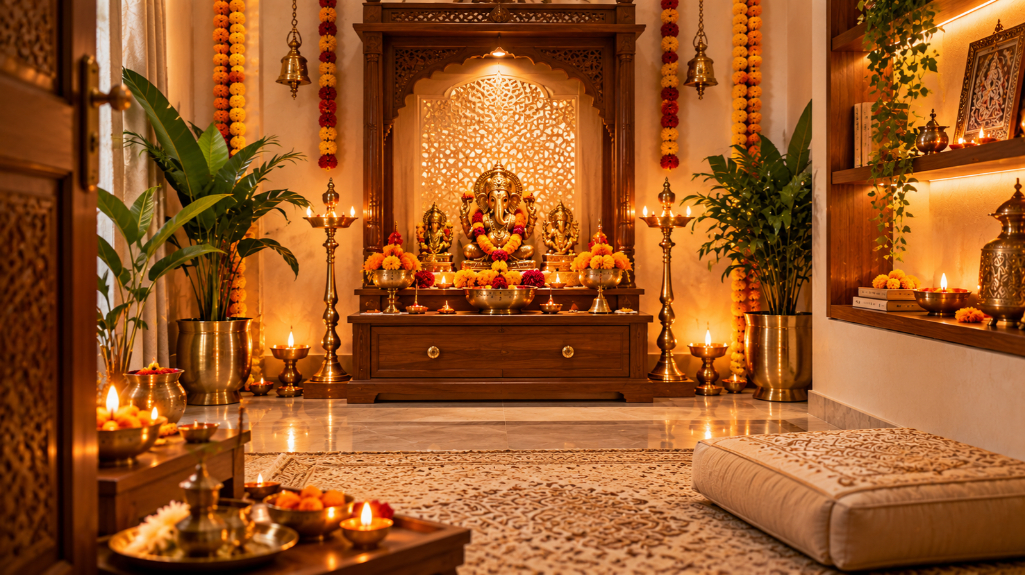
The pooja room or prayer corner receives the most attention and intention during Diwali of any space in the Indian home. This is Lakshmi Puja territory and the space should reflect that significance without becoming cluttered or visually overwhelming.
Diyas and lamps: quantity and arrangement
The traditional guidance is that Diwali should be lit with diyas, not left in darkness, which is why the festival’s name means row of lights. The pooja room should have diyas arranged in a symmetrical pattern on a flat surface at a comfortable puja height. Clay diyas, brass diyas and silver-finish diyas in graduated sizes create a layered, organised arrangement. Place the largest lamp or deepam centrally and arrange smaller diyas in a grid or circular pattern around it.
A floating diya arrangement in a brass or copper bowl of water with flower petals around it is both traditional and visually beautiful. The reflection of the flame in the water doubles the light and creates a gentle movement quality that static lamp arrangements do not have.
Brass and copper artefacts for the puja space
Brass and copper have been the traditional materials of Indian ritual spaces for thousands of years. Their warm metallic tones, their association with purity and their ability to hold flame all make them the natural choice for festive puja decor. A new brass puja thali, a set of small brass flower vases, a brass incense holder and a polished brass mirror for the deity installation are all practical and auspicious additions to any puja space for the Diwali season.
For buyers who want to upgrade their puja corner beyond diya arrangements, a hand-carved wooden puja mandap or a wall-mounted puja unit in sheesham with brass fittings creates a permanent, elevated sacred space that serves the home year-round while being particularly relevant during the festive period.
Flowers, garlands and fragrance
Fresh flowers and garlands in the puja space are traditional and important. Marigold, jasmine and rose are the three most commonly used festive flowers. For buyers who want a longer-lasting alternative to fresh flowers for the puja decor, high-quality artificial flower garlands in marigold or jasmine look remarkably authentic and hold their appearance through the entire festive season without requiring daily replacement.
Fragrance is the sense that most powerfully triggers the memory of Diwali for most Indian adults. Sandalwood agarbatti, camphor and fresh flowers collectively create the specific olfactory character of an Indian festive home that no visual element alone achieves. Incense holders in brass or wood complete the puja setup.
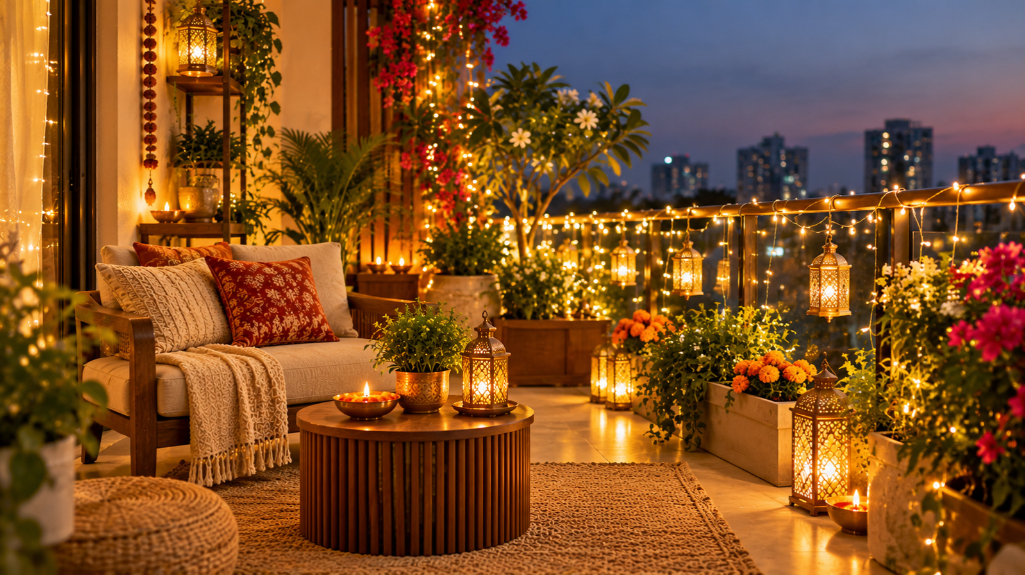
Section 5: The Balcony — Bringing Festive Light Outdoors
Indian apartment balconies come into their own during Diwali. The tradition of lighting the exteriors of homes during the festival of lights extends naturally to balconies, and a well-lit apartment balcony visible from the street below is both a festive statement and a beautiful urban contribution to the Diwali cityscape.
String lights and outdoor lighting
String lights are the most practical and most visually effective balcony lighting choice for Diwali. A 10 to 15 metre warm white or golden LED string light wound along the balcony railing, the ceiling edge of the balcony or around a large balcony plant creates a warm, festive glow that is visible both from inside the home and from the street.
For a more structured look, a curtain light (a sheet of LED strings hung vertically like a curtain) against the back wall of the balcony creates an impressive backdrop for balcony seating. These are particularly effective when guests gather on the balcony during Diwali evening and the vertical curtain of light behind them creates a memorable setting.
Diyas along the balcony railing or on the balcony floor edge (if the railing design allows for safe placement) continue the floor-level lighting tradition of Diwali into the outdoor space. Use windproof or enclosed lamp-style diyas for balcony use where wind can affect open-flame arrangements.
Balcony seating for festive gatherings
If the balcony currently has no seating, the festive season is the right moment to add it. A two-seater bistro set or a foldable outdoor chair pair creates a gathering point on the balcony that guests naturally gravitate to during the evening. For balconies above 60 square feet, a small outdoor sofa or a bench with outdoor cushions creates a more generous seating area suitable for the longer evening conversations that characterise Diwali gatherings.
Outdoor cushions in warm festive tones, deep orange, gold, burgundy or forest green, bring the interior festive palette into the balcony space and connect the indoor and outdoor areas visually. Cushion covers in weather-resistant polyester or canvas hold up to the brief outdoor exposure of festive evenings without requiring the same care as interior cushion fabrics.
| Balcony Diwali safety note When using diyas or any open flame on a balcony, keep them on a stable, non-flammable surface well away from string lights, curtains or any fabric. Never place open diyas directly beneath hanging string lights. A tray of clay or sand under the diya arrangement catches any spilled oil and prevents it from reaching the floor surface. Battery-operated or LED flameless diyas are the safe alternative for balconies where wind makes open-flame management difficult. |
Section 6: Room-by-Room Festive Shopping List and Budget Planner
Here is a complete festive home shopping list with realistic price estimates for every item mentioned in this guide, organised by room. Use this as your pre-Diwali shopping checklist and adjust quantities based on your specific home and budget.
Entrance
| Item | Estimated Cost | Priority |
| Fabric or beaded toran | Rs 200 to Rs 800 | Essential |
| Brass or terracotta entrance lamp pair | Rs 600 to Rs 2,000 | Essential |
| Rangoli doormat or door sticker | Rs 200 to Rs 600 | Essential |
| Decorative planter with marigold | Rs 500 to Rs 1,500 | High impact |
| LED string lights for door frame | Rs 300 to Rs 800 | High impact |
Living room
| Item | Estimated Cost | Priority |
| Festive cushion cover set (5 covers) | Rs 800 to Rs 2,500 | Essential |
| New rug or carpet (if needed) | Rs 2,500 to Rs 6,000 | High impact |
| Festive curtains or sheer layer | Rs 1,500 to Rs 5,000 | High impact |
| Wall art or metal wall sculpture | Rs 1,500 to Rs 6,000 | High impact |
| Table lamp or floor lamp upgrade | Rs 1,000 to Rs 3,000 | High impact |
| LED string lights for shelves or TV unit | Rs 300 to Rs 800 | Good to have |
| Brass or Dhokra centre table objects | Rs 800 to Rs 3,000 | Good to have |
| Scented candles or diffuser | Rs 400 to Rs 1,200 | Good to have |
Pooja room and prayer corner
| Item | Estimated Cost | Priority |
| Clay diya set (12 to 24 pieces) | Rs 100 to Rs 400 | Essential |
| Brass diya set (decorative) | Rs 600 to Rs 2,500 | Essential |
| Brass puja thali | Rs 400 to Rs 1,500 | Essential |
| Floating diya bowl (brass or copper) | Rs 500 to Rs 2,000 | High impact |
| Marigold or jasmine garland set | Rs 100 to Rs 400 | Essential |
| Incense holder with agarbatti | Rs 200 to Rs 600 | Essential |
| Small brass flower vases (pair) | Rs 400 to Rs 1,200 | Good to have |
Balcony
| Item | Estimated Cost | Priority |
| LED string lights (10 to 15 metres) | Rs 400 to Rs 1,200 | Essential |
| Windproof diyas or enclosed lamps | Rs 300 to Rs 800 | Essential |
| Festive outdoor cushion covers | Rs 600 to Rs 1,500 | High impact |
| Planter with seasonal plant | Rs 400 to Rs 1,200 | High impact |
| Outdoor bistro chairs (if no seating) | Rs 2,500 to Rs 6,000 | Investment |
Complete festive home budget summary
| Budget Level | What It Covers | Estimated Total Spend |
| Minimal festive refresh | Entrance decor, cushion covers, diyas across rooms | Rs 3,000 to Rs 6,000 |
| Standard festive makeover | All of the above plus rug, curtains, string lights | Rs 8,000 to Rs 18,000 |
| Full festive transformation | All of the above plus wall art, lamps, outdoor furniture upgrade | Rs 20,000 to Rs 40,000 |
| Order at least 3 weeks before Diwali The biggest festive home shopping mistake Indian buyers make is ordering too late. In the three weeks before Diwali, delivery timelines stretch, popular items go out of stock and express delivery premiums add 15 to 30 percent to the order cost. Cushion covers, curtains, rugs and lighting products sell out fastest. Order by early October for Diwali in late October or early November. Items that are already in stock ship faster than made-to-order or seasonal items that are produced in response to demand. |

Section 7: Festive Gifting Ideas from Your Home Decor Range
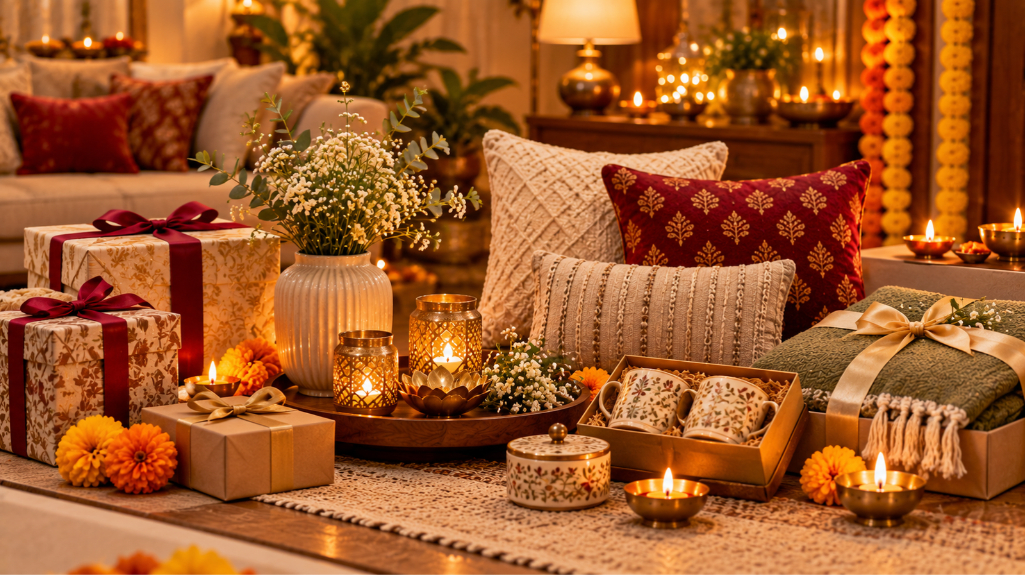
Diwali is also India’s biggest home gifting season. Visiting friends and family during the festival with a thoughtful home decor gift is a tradition that has grown significantly alongside the premium gifting market. Here is a guide to home decor gifts that are appropriate for every relationship and every budget.
| Recipient | Gift Idea | Price Range | Why It Works |
| Close family | Brass puja thali set or decorative brass lamp | Rs 800 to Rs 3,000 | Traditional, auspicious, lasts for years |
| New homeowners | Handicraft artefact set or Dhokra figurine pair | Rs 1,500 to Rs 5,000 | Unique, personal, no duplicates |
| Colleagues or clients | Scented candle and brass holder gift set | Rs 500 to Rs 1,500 | Safe, elegant, universally appreciated |
| Friends | Festive cushion cover set with a brass tray | Rs 1,200 to Rs 3,000 | Useful, colourful, immediately usable |
| Neighbours | Planter with marigold or seasonal plant | Rs 400 to Rs 1,200 | Festive, thoughtful, grows over time |
| In-laws | Premium brass or Dhokra sculpture for living room | Rs 3,000 to Rs 10,000 | Premium, cultural, statement piece |
| Anyone with a home bar | Handcrafted brass barware or drinkware set | Rs 1,500 to Rs 5,000 | Unique, practical, no generic sweets |
Frequently Asked Questions About Festive Home Decor in India
How do I decorate my home for Diwali on a budget?
The highest-impact, lowest-cost Diwali home decor changes are diyas (Rs 100 to Rs 400 for a set of 24), cushion cover replacements (Rs 800 to Rs 2,500 for a set of five), LED string lights (Rs 300 to Rs 800), a toran for the entrance (Rs 200 to Rs 800) and fresh marigold flowers at the entrance and in the pooja room. A complete festive refresh that covers the entrance, living room and pooja room can be achieved for Rs 3,000 to Rs 6,000 with this prioritised approach. Spend on the entrance and the living room first because these are the spaces that guests see and that create the festive atmosphere for the whole home.
What colours are best for Diwali home decor?
Deep jewel tones are the most festive and most traditionally resonant colour palette for Diwali: gold, deep orange, burgundy, emerald green, royal blue and rich purple all carry the warmth and richness associated with the season. These tones work particularly well in cushion covers, curtains and table runners. Warm metallic tones, gold, brass and copper in accessories and diyas, complement jewel tone textiles beautifully. Avoid pale, muted or very cool tones like grey, taupe and cool white for Diwali decor as they read as subdued rather than festive in the context of the season.
Which lights are best for home decoration during Diwali?
Warm white or golden yellow LED string lights at 2700K are the most appropriate and most universally flattering festive lighting for Indian homes. They replicate the warm glow of traditional diyas in electric form and photograph beautifully. For outdoor balcony use, weatherproof LED string lights rated for outdoor exposure are essential. Avoid cool white, blue or multicoloured string lights for interior festive use as they read as party lighting rather than the warm, auspicious glow associated with Diwali. Combine LED string lights with real clay or brass diyas for the best result: the flicker of real flame alongside the consistent warmth of LED creates the ideal festive atmosphere.
How early should I start decorating for Diwali?
Ideally three to four weeks before Diwali for ordering and two weeks before for physical decoration. Ordering three to four weeks ahead ensures you receive everything before stock runs out and delivery timelines stretch during peak demand. The physical decoration of the home works best done room by room across two weekends: entrance and living room in the first weekend, dining area, pooja room and balcony in the second. This paced approach prevents the exhaustion and rushed decision-making that characterises last-minute festive decoration and gives you time to rearrange or add items before guests arrive.
What is the best Diwali gift for someone who has just moved into a new home?
A handcrafted home decor piece is the best Diwali gift for a new homeowner. Choose something that is both beautiful and culturally resonant: a Dhokra brass figurine, a set of hand-hammered brass bowls, a framed Madhubani or Warli painting, a quality brass diya set or a decorative planter with a ceramic pot. These gifts are unique, have genuine artisan value and become a permanent part of the new home rather than being used once and forgotten. A budget of Rs 1,500 to Rs 5,000 covers a genuinely meaningful gift in this category. Avoid generic chocolate boxes, dry fruit sets or anything pre-packaged as a Diwali hamper without a home decor component, as these are immediately consumed and leave no lasting impression in the new home.
How do I make my balcony look festive for Diwali?
A balcony can be transformed for Diwali in under an hour with three elements: warm LED string lights along the railing or ceiling edge, diyas or enclosed outdoor lamps placed safely away from any fabric, and a decorative planter with marigold or another seasonal flower. Add festive-coloured outdoor cushion covers to any existing balcony seating to connect the balcony to the indoor festive palette. For balconies visible from the street or from other apartments, a curtain light against the back wall of the balcony creates a spectacular festive display that requires no elaborate arrangement and takes fifteen minutes to hang.
Shop Your Complete Diwali Home Makeover at Apka Interior
Everything you need for a complete Diwali home transformation is available at Apka Interior, from festive cushion covers, curtains and rugs to handcrafted artefacts, brass decor, string lights and outdoor planters. Plan your order at least three weeks before Diwali to ensure delivery before the season begins.
Browse our Festive Cushion collection for jewel-tone covers in block print and traditional Indian patterns. Explore our Curtain range for velvet and silk-look festive options in deep festive tones. Find statement Paintings and Sculptures and Handicraft and Artefacts for gifting and home display. Light your home with our Indoor and Outdoor Lights collection including warm LED string lights and decorative lamps for every room. And dress your entrance and balcony with our Planter and Plants range featuring terracotta, ceramic and brass planter options suited to every festive setting.
| Apka Interior festive promise We deliver across 22 cities in India. Order by the first week of October for guaranteed pre-Diwali delivery. Call our team on 1800-8890-891 Monday to Saturday between 10:30 AM and 6:30 PM for bulk gifting orders, interior consultation or any assistance with your festive home planning. |