
Tiles vs Vinyl vs Wooden vs Stone: Which Flooring Is Actually Best for Each Room in Your Indian Home?
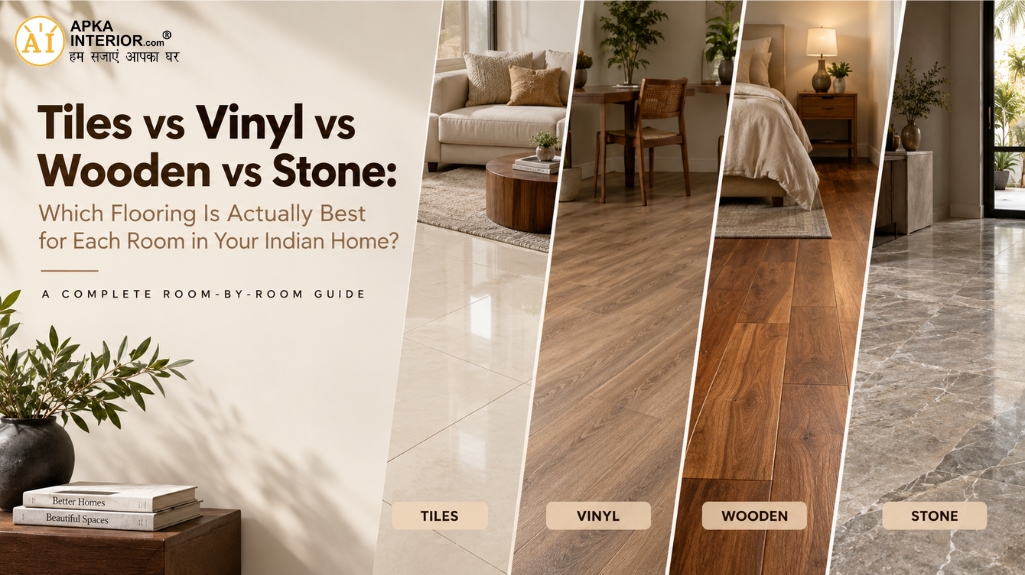
Flooring is the most permanent decision in any home renovation. You can change your sofa in a weekend. You can repaint a wall in an afternoon. You can swap curtains in minutes. Flooring requires breaking out tile, laying a new base, living with dust and noise for days and spending money you cannot recover. Getting it right the first time is not just about aesthetics. It is about avoiding one of the most expensive and disruptive reworks in home renovation.
The Indian flooring market has expanded enormously in the last decade. Where most Indian homes once had the same vitrified tile throughout, buyers today can choose from ceramic tiles, natural stone, engineered wood, solid wood, luxury vinyl planks, carpet and a growing range of hybrid options. The information available about these options is either too technical, too generic for Indian conditions or written by flooring contractors who have a product to sell.
This guide cuts through all of that. We cover every flooring type available in India, what each one costs per square foot, how it performs in Indian heat and humidity, which room it is genuinely suited for and what the honest limitations are. Read this before you speak to a contractor or visit a tile shop and you will go in knowing exactly what you want and why.
Section 1: The Five Flooring Types Available in India
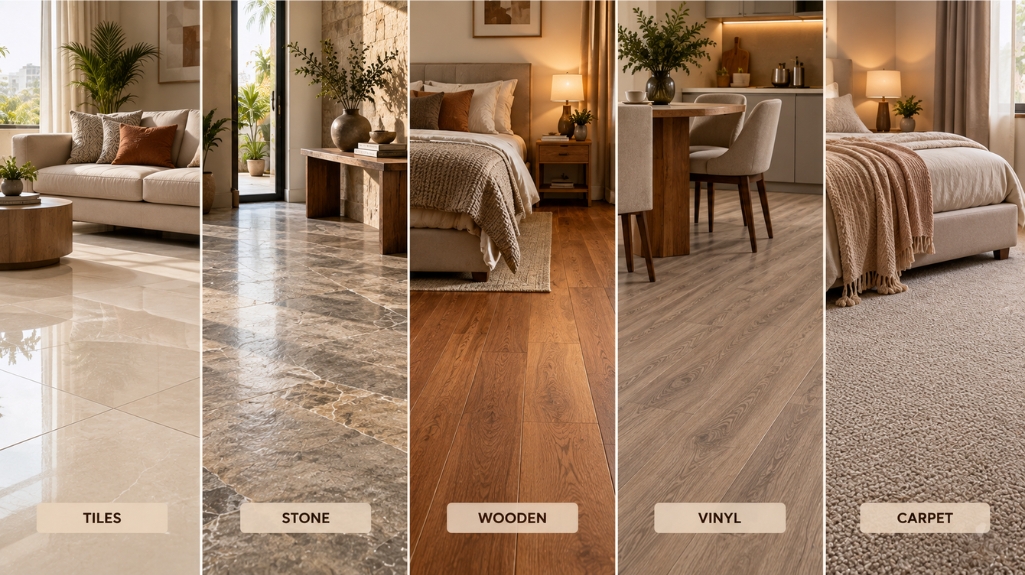
Before comparing options, here is a clear overview of each flooring category. Understanding what each material is made from is the first step to understanding how it performs.
1. Ceramic and Vitrified Tiles
Tiles are the most widely used flooring material in India and have been for decades. Ceramic tiles are made from clay fired at high temperatures with a glazed surface on top. Vitrified tiles go through an additional process that fuses silica into the clay body, making the tile extremely hard, dense and almost non-porous. The result is a tile that is significantly more stain-resistant, scratch-resistant and moisture-resistant than basic ceramic.
Vitrified tiles are the standard for most Indian home flooring today, available in sizes from 30 by 30 centimetres to large-format 120 by 120 centimetre slabs. The surface finish options include polished (high gloss), matte, satin and textured finishes. Large-format tiles with minimal grout lines give rooms a more seamless, premium appearance and have become increasingly popular in Indian homes as tile cutting technology has improved.
Ceramic tiles are suitable for walls, backsplashes and areas with lighter foot traffic. For floor applications in Indian homes, vitrified tiles are the more durable and practical choice.
2. Natural Stone Flooring
Natural stone flooring includes marble, granite, limestone, slate and sandstone. Each is quarried directly from the earth, cut into slabs or tiles and installed with adhesive and grout. Indian homes have a long tradition of using natural stone: Rajasthani kota stone, Agra red stone, Kerala laterite and Jaisalmer yellow stone are regional materials that carry both visual beauty and genuine material heritage.
Natural stone is heavy, cold underfoot and requires sealing to resist stains. Marble is the most aspirational of the stone flooring options and is widely used in premium Indian homes and hotels. It requires careful maintenance because it is porous and susceptible to acid staining from common household spills like lemon juice, vinegar and some cleaning products. Granite is harder, denser and more stain-resistant than marble, making it a better practical choice for kitchens and high-traffic areas.
Stone flooring significantly adds to the construction cost because of the material weight, cutting requirements and the skill level needed for proper installation. However, well-maintained stone flooring can last the lifetime of a building, which no other flooring category matches.
3. Engineered and Solid Wood Flooring
Wooden flooring comes in two forms in the Indian market. Solid wood flooring is exactly what it sounds like: planks milled from solid timber, typically teak, oak, walnut or bamboo. Engineered wood flooring has a real wood veneer on top (2 to 6 millimetres thick) bonded to a plywood or HDF core underneath. The core gives engineered wood dimensional stability that solid wood does not have, making engineered wood significantly more resistant to the expansion and contraction that Indian humidity cycles cause in solid wood floors.
For Indian conditions, engineered wood flooring almost always makes more practical sense than solid wood. The veneer surface looks and feels identical to solid wood but the engineered core handles the monsoon humidity and summer dryness that cause solid wood to gap, cup or buckle. Solid wood flooring requires very controlled indoor humidity levels year-round to perform well, which means continuous air conditioning in most Indian climates.
Wood flooring is warm underfoot, quiet and adds a premium quality to any room that no tile or stone can replicate. It requires regular care, is not suitable for wet areas and needs refinishing every several years depending on use and the thickness of the wear layer.
4. Luxury Vinyl Flooring (LVP and LVT)
Luxury vinyl flooring, sold as Luxury Vinyl Plank (LVP) or Luxury Vinyl Tile (LVT), is a synthetic flooring product that mimics the appearance of wood or stone extremely convincingly through high-resolution photographic printing on the surface layer. Modern luxury vinyl is not the thin, slippery vinyl sheet flooring of older Indian homes. It is a multi-layer product with a rigid or semi-rigid core, a printed design layer, a wear layer that protects the surface and sometimes an attached acoustic underlay.
Luxury vinyl has become one of the fastest-growing flooring categories in India for several very good reasons. It is 100 percent waterproof, handles Indian humidity without any expansion or warping, installs quickly with a click-lock system that does not require adhesive, and costs significantly less than the wood or stone it visually imitates. It is also softer and warmer underfoot than tiles. For Indian apartment buyers who want a wood-look floor without the maintenance and moisture sensitivity of real wood, luxury vinyl is an increasingly compelling option.
5. Carpet Flooring
Carpet is the warmest, softest and quietest of all flooring options. It is available in broadloom form (fitted wall to wall) or as carpet tiles (modular squares that can be mixed and replaced individually). In Indian homes, fitted carpet is used almost exclusively in bedrooms and study rooms where foot comfort and acoustic softness are the priority.
The challenge with carpet in India is maintenance in the context of Indian household habits, Indian dust levels and Indian climate. Carpet absorbs dust, pollen, pet hair and spills more than any hard surface flooring. In high-dust environments like Delhi NCR or in coastal humid cities like Mumbai and Chennai, carpet requires more frequent deep cleaning than most Indian households manage. Anti-microbial and stain-resistant carpet treatments help significantly but do not eliminate the maintenance requirement.
Carpet tiles (modular carpet) are more practical for Indian use than broadloom because individual damaged or stained tiles can be replaced without replacing the entire floor. This makes them better suited to Indian rental homes and children’s rooms where localised damage is common.
| Flooring Type | Water Resistance | Heat Resistance | Scratch Resistance | Maintenance | Lifespan | Cost per Sq Ft |
| Vitrified tiles | Excellent | Excellent | Excellent | Very low | 50 plus years | Rs 40 to Rs 200 |
| Natural stone | Moderate to good | Excellent | Good to excellent | Moderate | Lifetime | Rs 80 to Rs 500 |
| Engineered wood | Moderate | Good | Moderate | Medium | 15 to 25 years | Rs 120 to Rs 350 |
| Solid wood | Low | Moderate | Moderate | High | 30 plus years with care | Rs 200 to Rs 600 |
| Luxury vinyl (LVP) | Excellent | Moderate | Good | Very low | 15 to 25 years | Rs 60 to Rs 180 |
| Carpet (broadloom) | Poor | Good | Not applicable | High | 8 to 12 years | Rs 40 to Rs 150 |
| Carpet tile (modular) | Poor | Good | Not applicable | Moderate | 10 to 15 years | Rs 50 to Rs 180 |
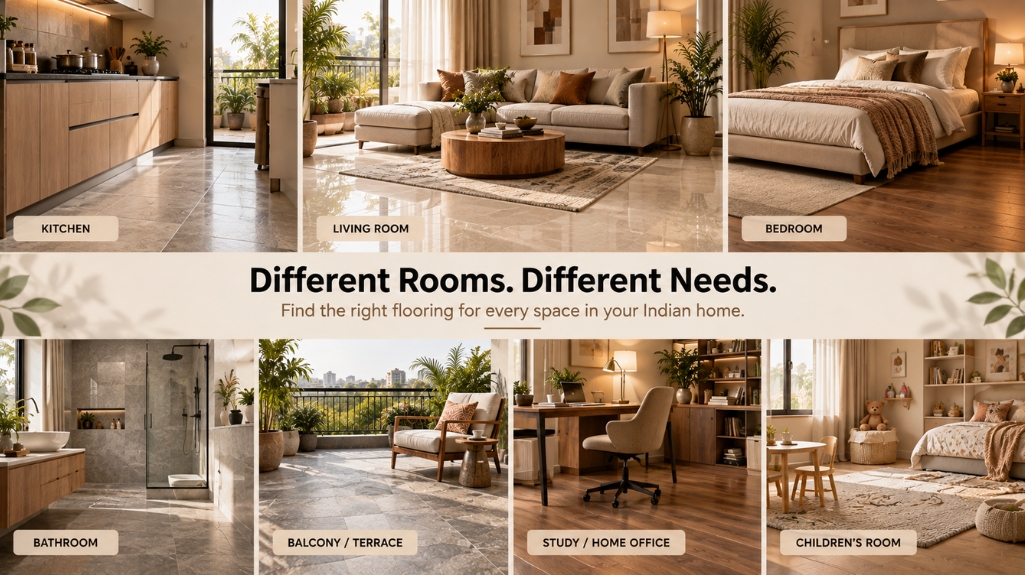
Section 2: Room-by-Room Flooring Recommendations
Every room in an Indian home has different requirements from its floor. High-traffic areas need durability. Wet areas need moisture resistance. Sleeping areas need warmth and quiet. Getting the flooring right for each room is more important than choosing one floor for the whole house.
Kitchen
The Indian kitchen floor faces the most demanding conditions of any room in the home. High heat, daily spills of oil and water, heavy pots dropped from counter height and constant foot traffic make this the room where flooring failure happens fastest if the wrong material is chosen.
Anti-slip vitrified tiles are the correct flooring choice for Indian kitchens without exception. The anti-slip specification (coefficient of friction above 0.6 on the product specification) is essential because oil and water spills create a highly slippery surface on polished tiles. Matte or textured finish vitrified tiles provide this slip resistance without sacrificing the ease of cleaning that makes tiles the right material for kitchen floors. Natural stone (particularly granite) is an excellent premium alternative for kitchen floors, as granite is hard, heat-resistant and far more stain-resistant than marble.
Avoid wooden flooring, vinyl and carpet in Indian kitchens entirely. Wood warps from moisture and heat exposure. Vinyl edge joints lift where water infiltrates. Carpet in a kitchen is a hygiene problem that compounds rapidly with daily Indian cooking.
| Anti-slip specification for Indian kitchen tiles When buying kitchen floor tiles in India, look for the PEI rating (Porcelain Enamel Institute rating) of 4 or 5, which indicates suitability for heavy residential or light commercial use. Also check the slip resistance value (R-value or coefficient of friction): R10 or above for kitchen floors and R11 or above for any wet area where water stands on the surface. These specifications are increasingly available on product listings in India and are the only objective measure of slip resistance. Do not rely on the word slip-resistant without a specification number. |
Living room
The living room floor is the visual centrepiece of the home. It is also a moderate-traffic area that does not face the moisture and heat extremes of the kitchen or bathroom. This gives you the most design flexibility of any room in the house.
Large-format vitrified tiles in a polished or matte finish are the most popular living room flooring choice in Indian homes today and remain an excellent option. Sizes from 80 by 80 centimetres to 120 by 60 centimetres with minimal grout lines give Indian living rooms a seamless, premium quality that smaller tiles cannot match.
Engineered wood or luxury vinyl plank flooring in a wood-look finish has grown significantly in Indian living room popularity because it adds warmth and texture that tiles cannot provide. For families who want a warmer-looking, quieter living room floor, engineered wood on a concrete sub-floor with a moisture barrier is achievable in most Indian apartments and makes a genuine qualitative difference to the feel of the room.
Natural stone, particularly marble or sandstone, is the premium living room flooring choice for those who want timeless elegance. The maintenance requirement is higher, particularly for marble, but the visual quality of a well-laid natural stone living room floor is not matched by any manufactured product.
Bedroom
The bedroom floor is walked on barefoot more than any other floor in the home. Warmth underfoot, acoustic softness and visual calm are the priorities here, not the hardness and durability that matter most in the kitchen and living room.
Engineered wood flooring is the best bedroom floor choice for most Indian buyers who can accommodate the maintenance requirement. The warmth underfoot, the natural look and the acoustic softness all contribute to a bedroom environment that feels genuinely different from a tiled room. Pair with a large area rug at the bedside and foot-of-bed positions for maximum comfort.
Luxury vinyl plank flooring is the best practical alternative for bedrooms where budget does not allow engineered wood or where the building’s moisture levels make real wood floors risky. Good quality LVP in a wood-look finish is visually convincing and the waterproof properties mean accidental spills or humidity variations cause no damage.
Carpet is a comfortable bedroom flooring choice for buyers who prioritise foot warmth and acoustic softness and can commit to regular vacuuming and periodic professional cleaning. Anti-microbial, stain-treated loop pile carpet in neutral tones is the most practical carpet specification for Indian bedrooms. Avoid shaggy or high-pile carpet in Indian bedrooms because of the dust retention in Indian conditions.
Bathroom
Bathroom flooring in India has a specific and non-negotiable requirement: it must be anti-slip even when wet. Indian bathrooms are wet zone floors, meaning water is present on the surface frequently and the floor must provide grip whether the user is wearing wet feet, bathroom slippers or stepping directly from a shower.
Small-format anti-slip ceramic or vitrified tiles (20 by 20 centimetres to 30 by 30 centimetres) are the most practical bathroom floor choice. Smaller tiles mean more grout lines, and grout lines actually improve slip resistance because they provide additional traction points. Large-format tiles in a bathroom require a textured or high-grip surface to compensate for the reduced grout line density.
Natural slate is a traditional and excellent bathroom floor material. Its natural surface texture provides grip without needing an added anti-slip treatment. It requires sealing to prevent staining but is otherwise a very durable and characterful bathroom floor.
Never use polished marble, polished vitrified tiles or any smooth-surface material on a bathroom floor. The slip risk is real and severe. Even a matte-finish tile should be confirmed with a slip-resistance specification before installation in a bathroom.
| The one flooring rule that prevents the most bathroom injuries in India A polished or smooth floor tile in a bathroom that gets wet multiple times daily is a genuine safety hazard. The Indian bathroom is not the same use environment as a European one: Indian bathrooms involve standing water from bucket bathing, splashing from health faucets and the transition from dry to wet floors multiple times a day. R11 or above slip resistance is the correct specification for any Indian bathroom floor tile. Always verify this before purchase, not after laying. |
Balcony, terrace and outdoor areas
Outdoor flooring in India faces the full combination of Indian climate challenges: intense UV exposure, monsoon water, dry heat and in some cities, frost. The flooring material for any outdoor space must handle all of these without cracking, staining, becoming dangerously slippery when wet or degrading in colour and texture within a few seasons.
Natural stone is the best outdoor flooring material for Indian conditions. Kota stone, a fine-grained limestone quarried in Rajasthan, has been used for Indian outdoor flooring for centuries and remains one of the most practical choices. It is hard, naturally textured, handles temperature variation well, is available at a very accessible price point and ages beautifully. Granite is an excellent premium outdoor stone choice.
Anti-slip vitrified tiles specifically rated for outdoor use (frost-proof and UV-stable specifications) are a practical and stylish outdoor flooring option. Look for tiles with a natural-stone or wood-look texture rather than a polished surface. Outdoor tiles need a slip resistance rating of R12 or above because wet outdoor surfaces are more slippery than wet indoor ones.
Luxury vinyl is not suitable for outdoor use. It is not UV-stable and will fade, curl and delaminate in direct Indian sun within a season. Carpet outdoors is similarly unsuitable. Wood decking in teak or a high-quality composite material works well on covered verandahs and balconies with limited rain exposure but requires annual maintenance outdoors.
| Room | Best Flooring Choice | Acceptable Alternative | Avoid |
| Kitchen | Anti-slip vitrified tile (R10 plus) | Granite stone | Wood, vinyl, carpet |
| Living room | Large-format vitrified tile | Engineered wood, LVP, natural stone | Carpet (dust in Indian conditions) |
| Bedroom | Engineered wood, LVP | Matte vitrified tile with rug | Polished tile (cold underfoot) |
| Bathroom | Anti-slip ceramic or vitrified (R11 plus) | Natural slate | Polished tile of any type |
| Balcony or terrace | Natural stone, outdoor-rated anti-slip tile | Teak decking (covered only) | Vinyl, carpet, polished tile |
| Study or home office | Engineered wood, LVP, matte tile | Anti-microbial carpet tile | High-pile carpet (dust) |
| Children’s room | LVP or engineered wood | Anti-microbial carpet tile | Polished tile (noise, cold, fall risk) |
Section 3: Indian Climate and Flooring Performance
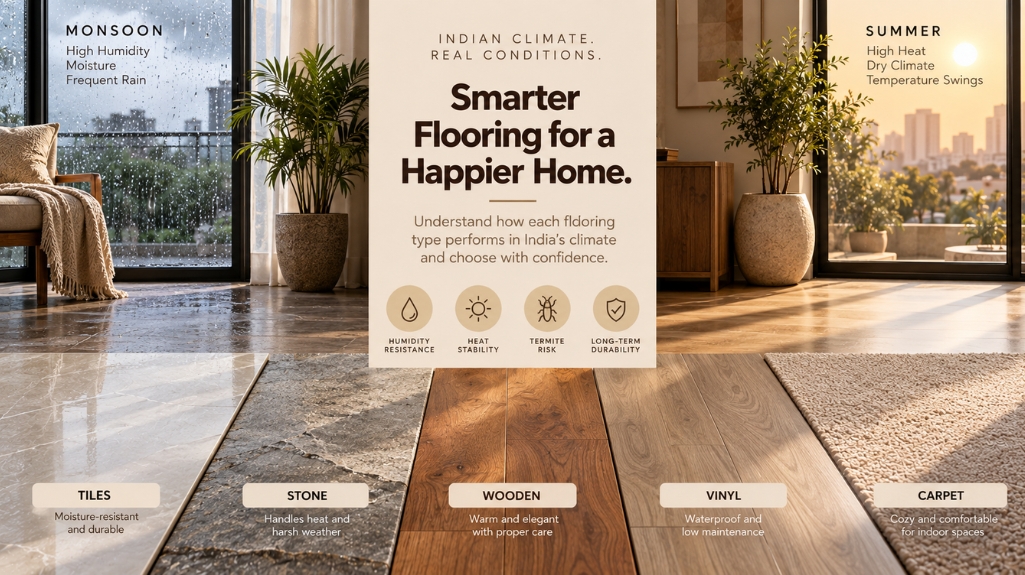
India’s climate is one of the most demanding environments on the planet for building materials. The same floor that performs brilliantly in a Norwegian home may crack, warp, stain or become a slip hazard within one Indian monsoon season. Here is how each flooring type responds to Indian climate conditions.
Monsoon and high humidity
The monsoon season is the greatest threat to wooden flooring in India. Solid wood absorbs atmospheric moisture and expands during the humid months, then contracts during the dry months. This repeated expansion and contraction causes gapping between planks in the dry season, cupping (edges raised above the centre) during the humid season and in severe cases, buckling where the floor lifts away from the subfloor entirely.
Engineered wood handles monsoon humidity significantly better than solid wood because the cross-grain plywood core resists dimensional change in a way that solid wood cannot. However, no real wood flooring should be installed in a room with no climate control if that room will be closed and unventilated through the monsoon months.
Luxury vinyl is 100 percent unaffected by humidity and is the safest flooring choice for any room in a high-humidity Indian city or building that does not have year-round air conditioning.
Vitrified tiles and natural stone are both fully moisture-stable, provided the grout between tiles is properly sealed. Degraded grout allows moisture infiltration beneath the tile, which eventually causes the tile to hollow and crack. Re-grouting every 5 to 7 years in high-humidity environments is a worthwhile maintenance investment.
Dry summer heat and temperature cycling
At the other extreme, dry summer heat in North and Central India creates a different set of flooring challenges. Vitrified tiles and natural stone are both fully heat-stable but can feel intensely cold underfoot during winter mornings in these climates, which is uncomfortable and can be a health concern for elderly residents.
Wood flooring in dry climates faces the contraction side of the humidity cycle, which causes visible gaps between planks during the driest months. A well-acclimatised installation with the correct expansion gaps and a moisture barrier beneath the floor minimises this but does not eliminate it entirely. Using a humidifier in the room during the driest months protects wood floors in dry-climate Indian cities.
Termites and ground-floor flooring
Ground-floor apartments and independent homes in India face a termite risk that upper-floor units do not. Termites travel through concrete and can attack wood flooring from below if the building has a termite problem. For any ground-floor installation of wood flooring in India, anti-termite treatment of the subfloor and use of a physical termite barrier membrane beneath the flooring are non-negotiable precautions. Luxury vinyl and tile flooring are not affected by termites.
| Pre-monsoon flooring maintenance checklist for Indian homes Before the monsoon: (1) Check all tile grout for cracks or gaps and re-grout any compromised areas to prevent moisture infiltration. (2) Apply a penetrating sealer to any natural stone floors, particularly marble and limestone. (3) Clean and re-coat engineered wood floors with the manufacturer-recommended finish if the surface has dulled. (4) Ensure all expansion gaps around the perimeter of wood or vinyl floors are clear and not sealed or blocked by skirting boards. (5) Check that bathroom floor drains are clear so water does not pond on the floor surface during heavy monsoon use. |
Section 4: Cost Guide for Indian Flooring in 2026
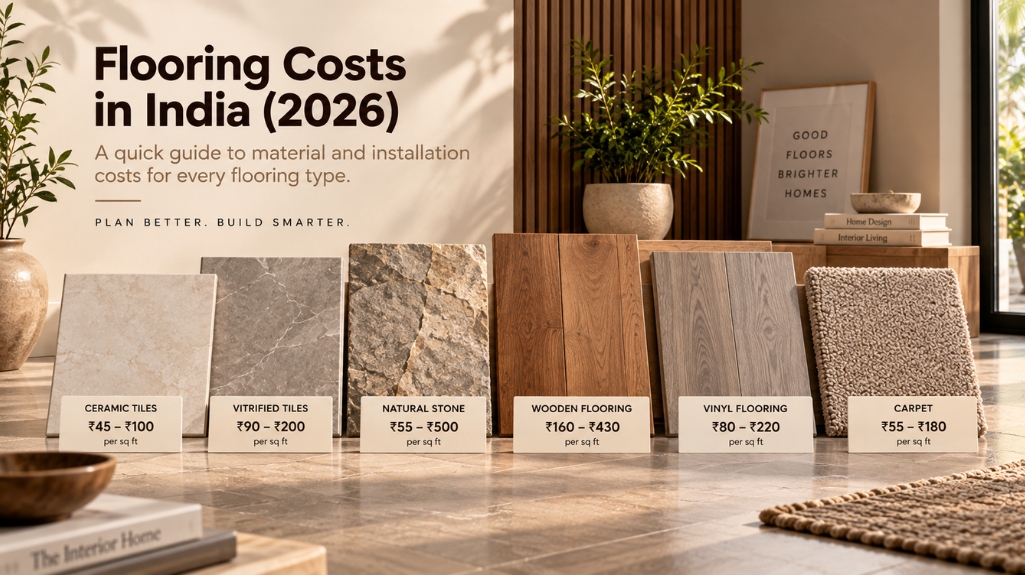
Flooring costs in India vary significantly based on material, brand, tile size, finish type and the cost of installation. Here is a realistic cost guide covering material cost per square foot and approximate installation cost ranges for each flooring type.
| Flooring Type | Material Cost (Rs per sq ft) | Installation Cost (Rs per sq ft) | Total Estimate (Rs per sq ft) | Notes |
| Basic ceramic tile | Rs 20 to Rs 60 | Rs 25 to Rs 40 | Rs 45 to Rs 100 | Suitable for bathrooms and utility areas |
| Mid-range vitrified tile | Rs 60 to Rs 150 | Rs 30 to Rs 50 | Rs 90 to Rs 200 | Most common Indian home floor choice |
| Premium large-format tile | Rs 150 to Rs 400 | Rs 50 to Rs 100 | Rs 200 to Rs 500 | Large cutting waste adds 10 to 15 percent |
| Kota or similar stone | Rs 25 to Rs 60 | Rs 30 to Rs 50 | Rs 55 to Rs 110 | Best value natural material for outdoors |
| Marble | Rs 80 to Rs 400 | Rs 50 to Rs 100 | Rs 130 to Rs 500 | Requires periodic sealing and polishing |
| Granite | Rs 60 to Rs 250 | Rs 50 to Rs 90 | Rs 110 to Rs 340 | More durable than marble, lower maintenance |
| Engineered wood | Rs 120 to Rs 350 | Rs 40 to Rs 80 | Rs 160 to Rs 430 | Includes moisture barrier cost in estimate |
| Luxury vinyl plank | Rs 60 to Rs 180 | Rs 20 to Rs 40 | Rs 80 to Rs 220 | Click-lock LVP has lower installation cost |
| Carpet (broadloom) | Rs 40 to Rs 150 | Rs 15 to Rs 30 | Rs 55 to Rs 180 | Pad/underlay adds Rs 10 to Rs 20 per sq ft |
| How to calculate total flooring cost for your home Measure each room in square feet by multiplying length by width in feet. Add 10 percent to the total for cutting waste in standard rooms and 15 percent for rooms with complex shapes, alcoves or many columns. Add the material cost, installation cost and the cost of any underlay, adhesive or grouting material. For a standard 1000 sq ft Indian apartment with mid-range vitrified tiles throughout, budget Rs 1,20,000 to Rs 2,00,000 including materials and installation. For engineered wood in bedrooms and tiles in living areas and wet areas, budget Rs 1,80,000 to Rs 3,00,000 for the same apartment size. |
Section 5: How to Identify Quality When Buying Tiles and Flooring Online
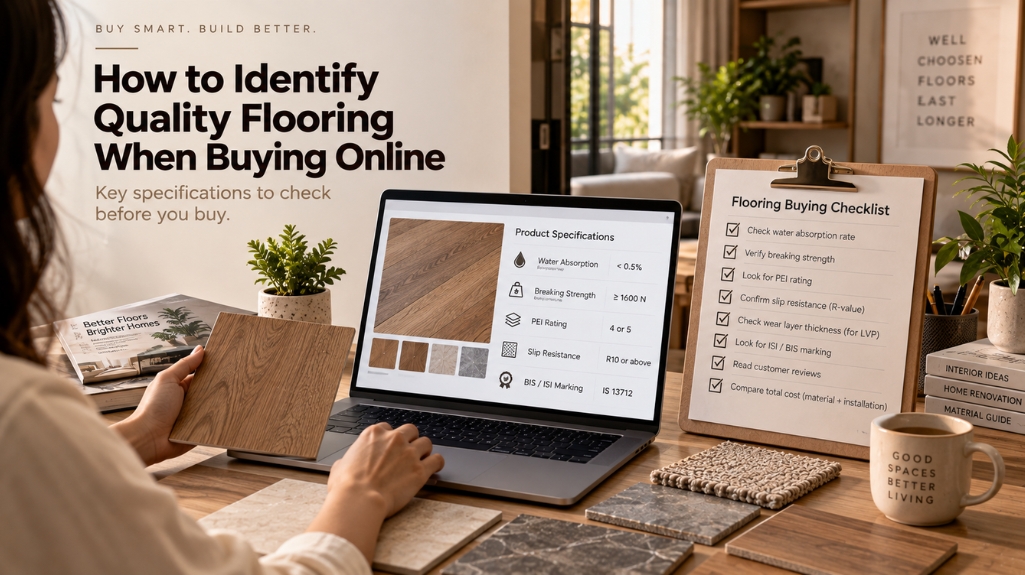
Buying flooring online in India has become common, particularly for tiles and luxury vinyl. But flooring is a product where the feel, weight and surface texture matter significantly and cannot be fully assessed from product photos. Here are the specifications and checks that replace the need to see the product in person.
- Water absorption rate: For vitrified tiles, look for water absorption below 0.5 percent. This confirms the tile is fully vitrified and dense. Values above 0.5 percent indicate a less fully vitrified tile that is more porous and less suitable for wet areas.
- Breaking strength: A tile rated at 1600 Newton breaking strength or above is suitable for floor use in a standard Indian residential setting. Tiles rated below 1000 Newton are wall tiles and should not be used on floors.
- PEI rating: PEI 3 is the minimum for light residential floors. PEI 4 is recommended for any Indian home floor, particularly in high-traffic areas like living rooms and hallways. PEI 5 is required for commercial spaces.
- Wear layer thickness for LVP: Luxury vinyl plank wear layer thickness determines how long the floor resists scratching. 0.3 millimetre (12 mil) wear layers are minimum for residential use. 0.5 millimetre (20 mil) is recommended for any Indian home with regular foot traffic. 0.7 millimetre (28 mil) and above is commercial grade.
- ISI marking: Look for ISI (Bureau of Indian Standards) marking on tiles. IS 13712 is the BIS standard for vitrified tiles. Products without BIS marking have not been independently tested to Indian standards.
Frequently Asked Questions About Flooring in India
Which flooring is best for the kitchen in an Indian home?
Anti-slip vitrified tiles with a PEI rating of 4 or above and a slip resistance of R10 or above are the best kitchen flooring choice for any Indian home. The combination of complete water resistance, excellent heat resistance, very low maintenance and the availability of anti-slip surface finishes makes vitrified tiles the only material that genuinely addresses all the demands of an Indian kitchen floor. Granite stone is an excellent premium alternative with similar performance characteristics. Wooden flooring, vinyl and carpet should not be used in Indian kitchens.
Does vinyl flooring suit the Indian climate?
Luxury vinyl plank (LVP) flooring performs well in Indian conditions in rooms with climate control. It is 100 percent waterproof, completely unaffected by humidity and handles temperature variation between seasons without any expansion, contraction or warping. The limitation is UV stability: luxury vinyl should not be used in areas with direct, prolonged sunlight exposure because the surface can fade and the core can become brittle over time in very high UV conditions. LVP is excellent for bedrooms, living rooms and study rooms in Indian apartments. It is not suitable for outdoor or semi-outdoor spaces.
Is wooden flooring practical in India?
Engineered wood flooring is practical in India when installed correctly in rooms with climate control. The engineered plywood core handles Indian humidity cycles significantly better than solid wood. For Indian cities with extreme humidity swings between summer and monsoon, running air conditioning in rooms with wood floors during the monsoon months protects the floor from excessive moisture absorption. Solid wood flooring is more demanding and generally suitable only for very well-controlled indoor environments. In cities like Mumbai or Chennai with year-round high humidity, engineered wood requires more careful management than in drier cities like Delhi or Jaipur.
What is the difference between ceramic and vitrified tiles?
Ceramic tiles are made from clay and fired at relatively lower temperatures, leaving a tile that is moderately porous and less dense. They have a visible colour difference between the surface glaze and the clay body underneath. Vitrified tiles undergo a process that fuses silica into the body of the tile at high temperature, making the tile non-porous, extremely dense and hard throughout. Vitrified tiles are significantly more durable, stain-resistant and water-resistant than ceramic tiles. For Indian home floors, vitrified tiles are the correct choice. Ceramic tiles are better suited to wall applications where their lower weight and easier cutting are advantages.
How much does flooring cost per square foot in India?
Material cost for mid-range vitrified tiles in India ranges from Rs 60 to Rs 150 per square foot. Installation adds Rs 30 to Rs 50 per square foot. For a standard mid-range vitrified tile installation including material, adhesive, grout and labour, budget Rs 90 to Rs 200 per square foot total. Engineered wood flooring ranges from Rs 160 to Rs 430 per square foot including installation. Luxury vinyl plank falls between Rs 80 and Rs 220 per square foot installed. Natural stone varies most widely, from Rs 55 per square foot for kota stone to Rs 500 per square foot for premium marble with professional installation.
Which flooring is best for balconies and terraces in India?
Natural stone, particularly kota stone, granite or sandstone, is the best balcony and terrace flooring material in Indian conditions. It handles direct UV exposure, monsoon rain, dry summer heat and the expansion and contraction of outdoor temperature cycles better than any manufactured flooring product. Anti-slip outdoor-rated vitrified tiles with an R12 or above slip resistance rating are a practical and stylish alternative. Luxury vinyl is not suitable for outdoor use. Wooden decking works on covered verandahs with limited rain exposure but requires annual oiling and is not recommended for open terraces. Avoid polished tile surfaces in any outdoor area: they become dangerously slippery when wet from rain.
Explore Flooring Options at Apka Interior
Every flooring category covered in this guide is available at Apka Interior. From anti-slip vitrified tiles and natural stone to engineered wood, luxury vinyl and carpet options, the full flooring range is available online with delivery across India.
Browse our Tiles collection for anti-slip kitchen tiles, large-format living room tiles and anti-slip bathroom options across every size and finish. Explore our Stone Flooring range for natural kota stone, marble and granite options. Find Wooden Flooring in engineered wood across multiple timber looks. Shop our Vinyl Flooring collection for waterproof LVP in wood and stone looks. And complete the look with Carpet Flooring options for bedrooms and study rooms in anti-microbial, stain-resistant specifications.