
Home Bar Setup Guide for Indian Homes: Everything You Need to Know Before You Buy
Something changed in how urban Indians entertain at home over the last few years. Dining out used to be the default. Now a growing number of households are investing in their own space for evening drinks, weekend hosting and casual gatherings. The home bar is no longer a luxury reserved for farmhouses and bungalows. It has become a genuine part of how thoughtfully designed Indian apartments are set up.
And yet, most people who want a home bar do not know where to start. How much space do you actually need? What is the right height for a bar counter? Do you need a dedicated cabinet or can you work with open shelves? What glassware matters, what is optional and what is just good to have? How much does a decent home bar actually cost?
This guide answers all of it. Whether you have a full room to dedicate to your bar, a corner in the living room or just a well-chosen cart that rolls out during parties, you will find a setup approach here that fits your space and your budget.
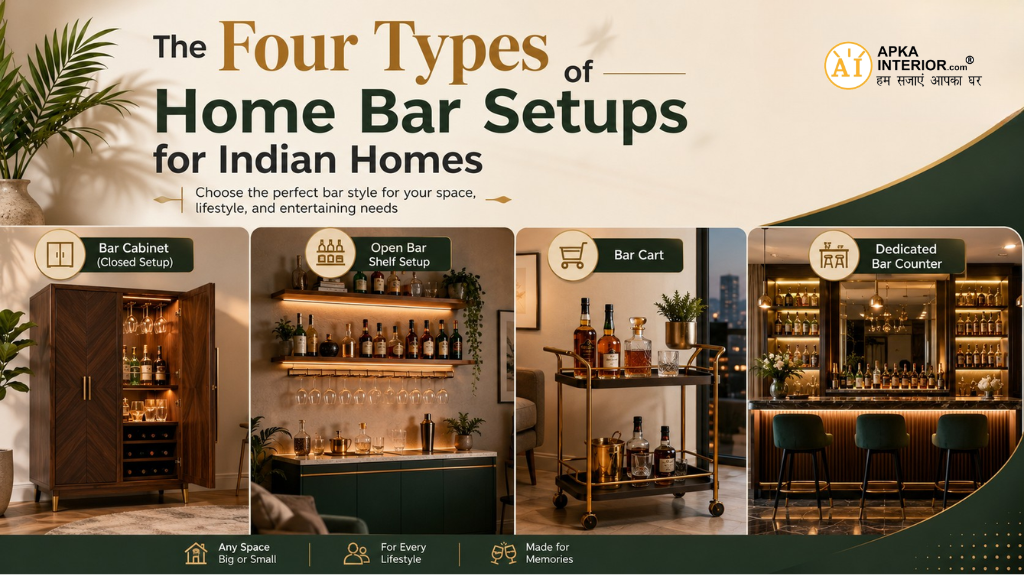
The Four Types of Home Bar Setups for Indian Homes
Before buying any furniture or accessories, the most important decision is which type of bar setup actually suits your home and your lifestyle. There is no single right answer. What works in a 3 BHK in Gurugram may not work in a 2 BHK in Bengaluru. Here are the four main options.
1. The Bar Cabinet (Closed Storage Setup)
A bar cabinet is a piece of furniture designed specifically for storing bottles, glasses and bar accessories behind closed doors. When the doors are shut, it looks like a standard piece of living room furniture. Open the doors and the full bar setup is revealed, often with bottle holders, glass racks and a small serving surface built in.
This is the most popular home bar format in Indian apartments because it contains everything neatly and does not announce itself to guests who are not meant to see it. It is ideal for homes where the bar needs to coexist with a formal or family-friendly living room. It requires the least floor space of any setup, typically needing just 90 to 120 centimetres of wall width.
| Best for: Apartments and homes where the bar needs to blend into existing decor. Buyers who want a complete, contained setup they can lock if needed. Anyone who hosts occasionally rather than regularly. |
2. The Open Bar Shelf Setup
Open shelving creates a bar that is always visible and becomes a part of the room’s decor. Think of a dedicated section of a bookshelf unit, a floating wall-mounted shelf cluster or a dedicated bar nook with exposed bottle display, hanging glass rack and visible barware.
This setup works beautifully when the bottles, glassware and accessories are curated thoughtfully, because they are always on display. It suits buyers who are proud of their collection and enjoy the visual of a well-stocked bar as part of their interior design. Open setups require a bit more ongoing organisation since there are no doors to hide anything behind.
In Indian homes, open bar shelves work particularly well in dedicated dining rooms, open-plan living and dining areas, or in a separate entertainment zone. Wall-mounted floating shelves with accent lighting above them are one of the most visually striking and affordable open bar approaches.
| Best for: Buyers who want the bar to be a design statement. Open-plan homes and apartments where the living and dining area flows together. Anyone with a curated bottle and glassware collection they want to display. |
3. The Bar Cart
A bar cart is a mobile trolley on wheels that holds bottles, glasses and accessories and can be moved from room to room or rolled out when entertaining and put away when not needed. Bar carts have seen a major surge in Indian interior design circles because they are flexible, affordable and look great in photographs.
The honest limitation of a bar cart is capacity. A standard bar cart holds four to eight bottles and a limited number of glasses. It suits buyers who maintain a small, well-chosen selection of spirits rather than a large collection. A bar cart is also not a permanent statement piece in the same way a bar cabinet or open shelf setup is. But for compact apartments, first-time home bar buyers and buyers who want to test the concept before committing to permanent furniture, a bar cart is an excellent starting point.
| Best for: Compact apartments and 1 BHK or 2 BHK setups where permanent bar furniture is not practical. First-time home bar buyers. Renters who need flexibility. Anyone who hosts occasionally and wants a setup they can move aside when not in use. |
4. The Dedicated Bar Room or Counter Bar
For villa owners, large apartment owners and buyers who have a dedicated spare room or a defined entertainment area, a full counter bar setup is the premium option. This involves a raised bar counter at the correct height with bar stools, a backbar display with shelves and mirror, under-counter storage and proper bar lighting.
This is the setup closest to what you see in a hotel or restaurant bar, built for a home. It requires more planning, more furniture pieces and a larger budget, but the result is a genuinely impressive entertainment space. Increasingly, Indian homeowners are converting a spare bedroom, a study corner or a section of a large living room into a dedicated bar zone as part of their interior design plan.
| Best for: Villa owners and large apartment buyers. Anyone who entertains regularly and wants a dedicated space. Buyers for whom the home bar is a serious design priority rather than an afterthought. |
How Much Space Does a Home Bar Actually Need?
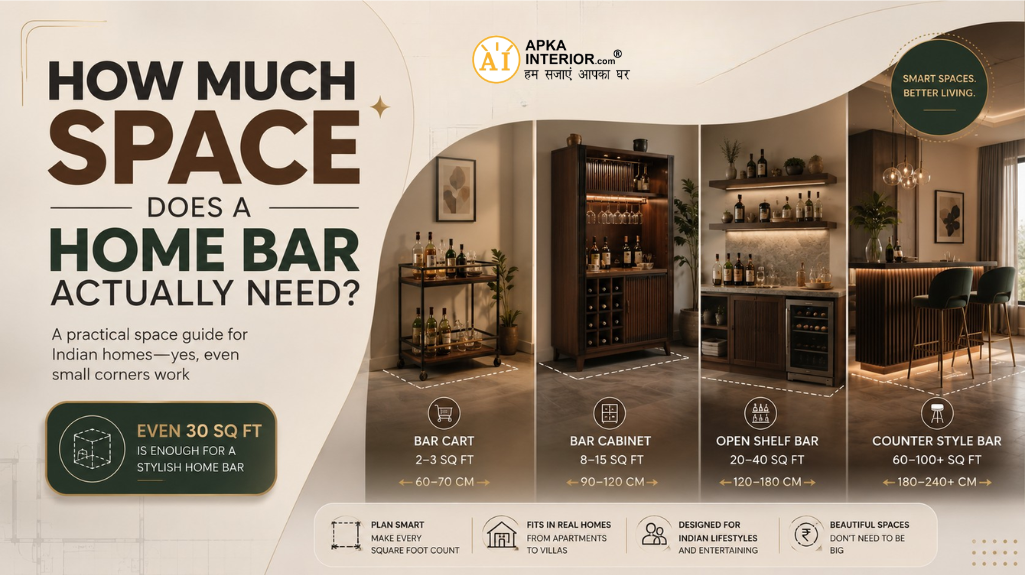
Space anxiety is one of the most common reasons Indian buyers hold back from setting up a home bar. The good news is that even a 30 square foot corner can support a functional and good-looking bar setup if it is planned correctly. Here is a realistic space guide.
| Setup Type | Minimum Space Needed | Ideal Space | Room Type |
| Bar cart | Any corner, 2 sq ft | 3 to 5 sq ft | Living room, dining area |
| Bar cabinet | 90 to 120 cm wall width | 120 to 150 cm width | Living room, bedroom corner |
| Open shelf bar | 60 to 90 cm wall width | 100 to 180 cm width | Dining area, living wall |
| Counter bar setup | 40 to 60 sq ft | 80 to 120 sq ft | Dedicated room, entertainment zone |
| Full bar room | 100 sq ft minimum | 150 to 200 sq ft | Converted room, villa annexe |
| Planning tip: Measure before you shop The biggest mistake in buying bar furniture is ordering a bar cabinet without accounting for door swing clearance. A bar cabinet with two doors needs roughly 60 to 80 cm of clear space in front of it so the doors can open fully without hitting a sofa or another piece of furniture. Measure both the wall width you have available and the clear space in front of it before placing an order. |
Bar Furniture Essentials for an Indian Home Bar
Once you know the setup type and the space available, you need to know exactly what furniture pieces make a home bar function well. Here is a breakdown by role.
Bar Cabinet or Bar Unit
The central storage piece. When choosing a bar cabinet, look for adjustable bottle holders that accommodate tall wine and spirit bottles (standard 750ml bottles are around 30 cm tall, some premium bottles are 35 cm), pull-out drawers or a base cabinet for additional storage and a pull-out or fold-down serving surface if the cabinet does not have a fixed counter top. Material matters here: solid wood and engineered wood with a good finish both work well. Avoid hollow-frame bar cabinets, which feel unstable and do not hold the weight of full bottles safely.
Bar Stools
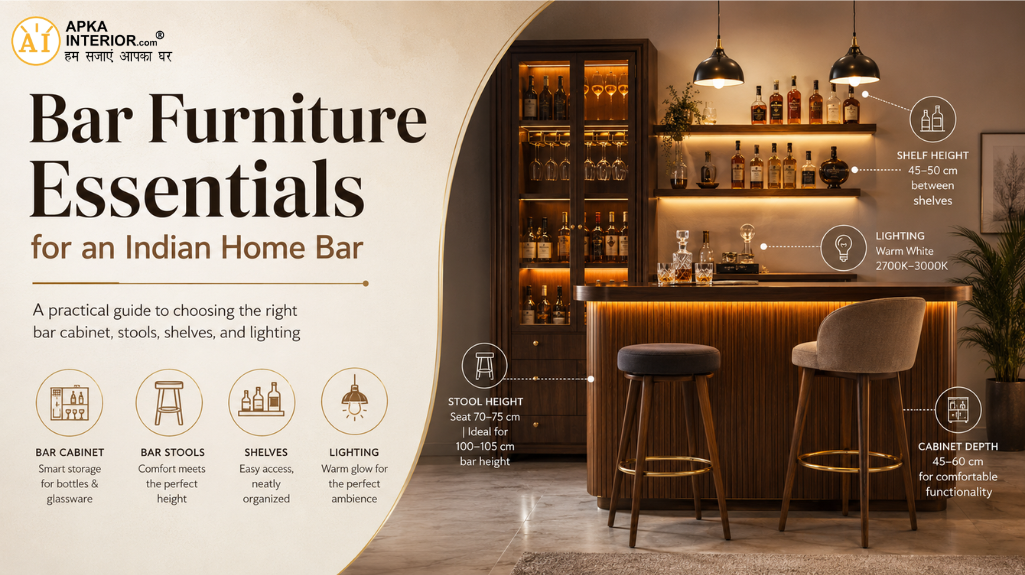
Bar stool height is one of the most commonly misunderstood specifications in home bar furniture. The correct stool height depends entirely on the counter height it is paired with. Here is the rule: there should be 25 to 30 cm of clearance between the seat of the stool and the underside of the counter.
| Counter Height | Correct Stool Seat Height | Stool Type |
| 75 cm (dining) | 45 to 50 cm | Standard dining chair height, not a stool |
| 90 cm (counter) | 60 to 65 cm | Counter-height stool |
| 105 cm (bar) | 73 to 78 cm | Bar-height stool (most home bars) |
| 110 to 115 cm | 78 to 82 cm | Extra tall bar stool |
Most Indian home bar counters are built at 105 cm height, which matches the standard 73 to 78 cm bar stool. If you are buying bar stools for a cabinet or counter whose height you do not know, measure before ordering. A stool that is too short feels awkward and uncomfortable, and one that is too tall means guests sit with their knees above the counter.
For stool design, backless stools save space and work well in tighter setups. Stools with backs and footrests are more comfortable for longer sitting sessions and suit counter bars where guests will sit for an extended time.
Bar Shelves
Floating wall shelves above the bar counter serve two purposes: display and storage. They create the classic back-bar look where bottles are arranged attractively at eye level. For an Indian home bar, two or three shelves staggered at different heights work better than a single long shelf. The lowest shelf should sit at roughly 150 cm from the floor so bottles on the counter do not block the view of the lower shelf. LED strip lighting along the underside of shelves elevates the look dramatically and is one of the most cost-effective bar upgrades available.
Lighting
Lighting makes more difference to a home bar than almost any other single element. Warm-white LED lighting creates the right atmosphere and is also functional for mixing drinks. Overhead spotlights directly above the bar counter are excellent for task lighting. LED strips under floating shelves create a backlit bottle display effect. A statement pendant light or cluster light above a counter bar ties the whole zone together visually.
Avoid cool-white or daylight temperature bulbs in a bar zone. The colour temperature of 2700K to 3000K (warm white) is what creates the intimate, inviting feel that a home bar should have.
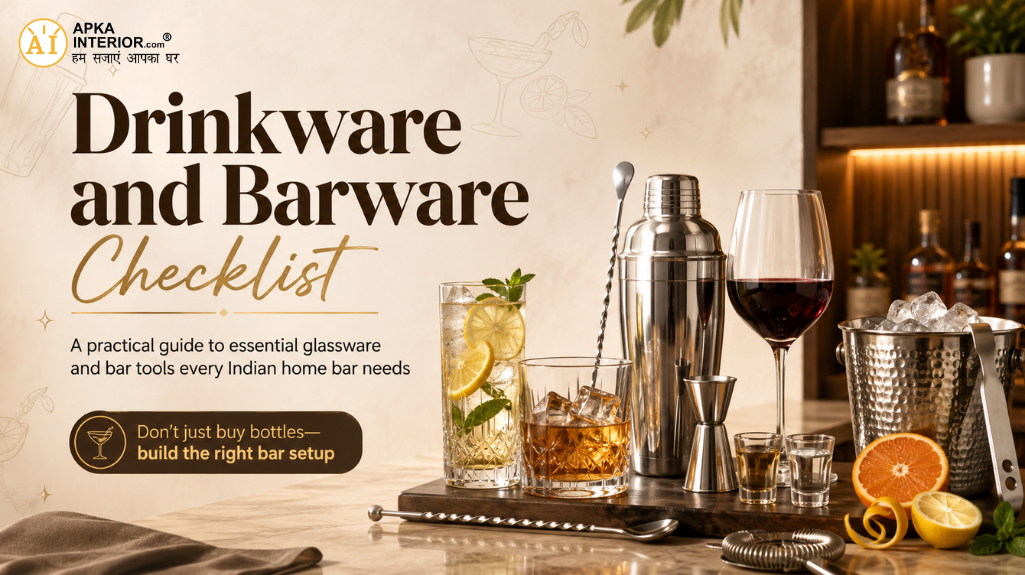
Drinkware and Barware Checklist
A home bar is only as good as its glassware and tools. Indian buyers often over-invest in bottles and under-invest in the equipment and glassware that make drinks actually enjoyable to serve and drink. Here is a practical checklist organised by priority.
Essential glassware (buy these first)
- Highball glasses Tall glasses for long drinks, G&T, whisky soda, mojitos. A set of 6 is the minimum.
- Old Fashioned or rocks glasses Short, wide glasses for neat pours, Old Fashioned cocktails and whisky on the rocks. Set of 4 to 6.
- Wine glasses Even if you serve wine infrequently, wine glasses are expected at any dinner-party bar. A set of 6 red wine glasses covers most needs. White wine glasses are optional if you are working with a budget.
- Shot glasses Small but essential for straight spirit pours and shooters. A set of 6 or 8 is ideal.
Good to have glassware (add as you go)
- Martini or cocktail glasses For classic stirred and shaken cocktails. Beautiful on display even when not in use.
- Champagne flutes For celebrations and festive occasions. A set of 4 is usually sufficient.
- Beer mugs or pint glasses If beer is a regular part of your entertaining.
- Copper mugs Specifically for Moscow Mules and some rum-based cocktails. More niche but increasingly popular.
Essential barware tools
- Cocktail shaker A standard Boston shaker or three-piece shaker. Non-negotiable if you make cocktails.
- Bar spoon For stirring drinks and layering cocktails. Much longer than a regular spoon.
- Jigger or measure For accurate spirit measurements. Guessing quantities is the fastest way to ruin a cocktail.
- Ice bucket with tongs Keeps ice accessible without guests reaching into a bag or tray. One of the highest-impact small purchases for a home bar.
- Bottle opener and corkscrew Obvious but often forgotten. Get a waiter’s friend style corkscrew that handles both wine and beer.
- Cutting board and bar knife For citrus garnishes, which go on more drinks than most people realise.
Nice to have barware
- Wine aerator or decanter For red wines that benefit from breathing.
- Cocktail strainer For straining shaken drinks over fresh ice.
- Muddler For mint mojitos, fruit cocktails and any drink that requires crushing fresh ingredients.
- Bottle stoppers For resealing opened wine bottles.
Budget Breakdown for Indian Home Bars
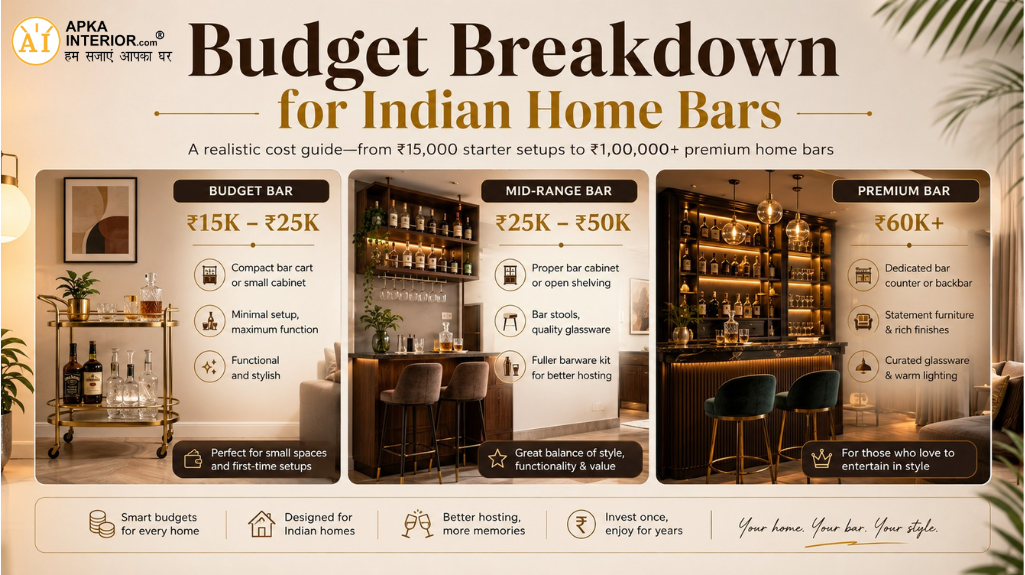
One of the most useful things this guide can give you is a realistic cost breakdown. Home bar budgets in India range from under Rs 15,000 for a simple cart-based setup to Rs 1,00,000 plus for a fully fitted counter bar. Here is what you can expect at three realistic budget levels.
Budget Bar: Rs 15,000 to Rs 25,000
At this budget you are building a functional, good-looking bar on a compact footprint. The bar cart or a small bar cabinet is your anchor piece.
| Item | Estimated Cost |
| Bar cart or compact bar cabinet | Rs 6,000 to Rs 10,000 |
| Basic glassware set (highball + rocks) | Rs 1,500 to Rs 2,500 |
| Essential barware (shaker, jigger, ice bucket) | Rs 1,000 to Rs 2,000 |
| Floating shelf (optional display shelf) | Rs 800 to Rs 1,500 |
| Bar accessories and organiser | Rs 500 to Rs 1,000 |
| Total estimate | Rs 10,000 to Rs 17,000 |
Mid-Range Bar: Rs 25,000 to Rs 50,000
At this budget you can invest in a proper bar cabinet or a curated open shelf setup with bar stools, quality glassware and a more complete barware kit.
| Item | Estimated Cost |
| Bar cabinet or open shelf unit | Rs 12,000 to Rs 22,000 |
| Bar stools (pair) | Rs 4,000 to Rs 9,000 |
| Full glassware set (4 glass types) | Rs 3,000 to Rs 5,000 |
| Complete barware kit | Rs 2,000 to Rs 4,000 |
| LED strip lighting for shelves | Rs 800 to Rs 1,500 |
| Decor, coasters and bar accessories | Rs 1,000 to Rs 2,500 |
| Total estimate | Rs 23,000 to Rs 44,000 |
Premium Bar: Rs 60,000 and above
At this level you are building a dedicated entertainment zone with a counter or backbar setup, quality statement furniture, curated glassware and full lighting.
| Item | Estimated Cost |
| Premium bar cabinet or counter setup | Rs 25,000 to Rs 55,000 |
| Bar stools (set of 3 or 4) | Rs 10,000 to Rs 20,000 |
| Premium glassware set | Rs 6,000 to Rs 12,000 |
| Complete barware and accessories | Rs 4,000 to Rs 8,000 |
| Shelving and lighting | Rs 5,000 to Rs 10,000 |
| Decor, artwork, mirror | Rs 3,000 to Rs 8,000 |
| Total estimate | Rs 53,000 to Rs 1,13,000 |
Style Directions for Indian Home Bars
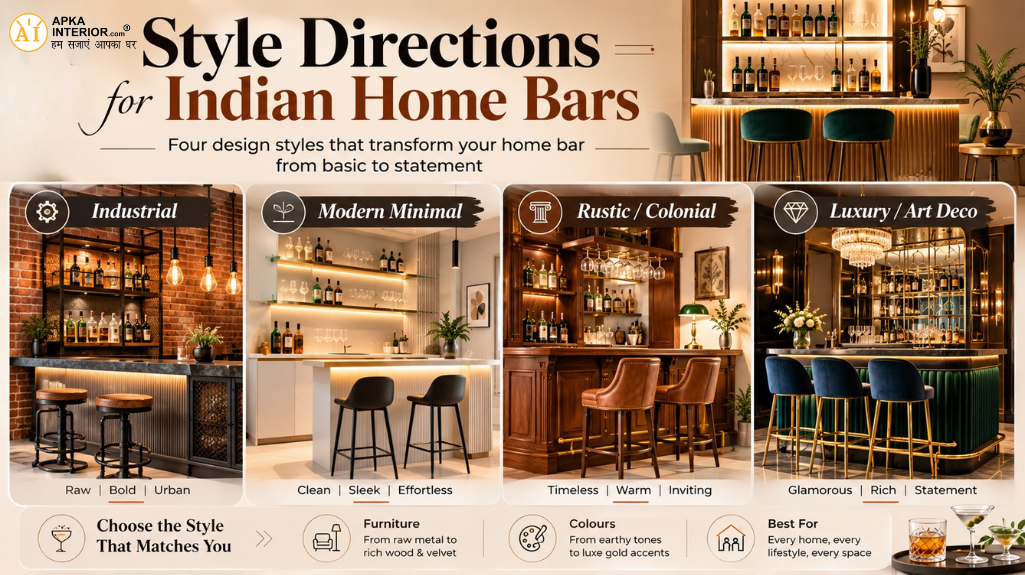
A home bar should feel like a deliberate design choice, not an afterthought. Here are the four most popular style directions that work well in Indian homes right now.
Industrial
Raw metal frames, reclaimed wood shelves, Edison bulb pendant lights and concrete or dark stone counter tops. This look is bold, masculine and works particularly well in apartments with exposed brick walls or in homes that lean toward a modern-industrial interior. Dark-toned bar cabinets with metal hardware and pipe-style bar stools are the go-to furniture choices for this style.
Modern Minimal
Clean lines, matte finishes, monochromatic colour palette and understated hardware. A white or light oak bar cabinet with integrated push-to-open doors, backless bar stools in chrome or matte black and simple glass shelving with warm LED strip lighting. This style photographs beautifully and suits contemporary Indian apartment interiors that already lean minimalist.
Rustic or Colonial
Solid wood furniture in walnut or teak tones, leather-upholstered bar stools, vintage-style glassware and aged brass hardware. This style has a warm, lived-in quality that makes it inviting and approachable. It suits Indian bungalows, heritage homes and apartments that have traditional or transitional interiors.
Luxury or Art Deco
Rich jewel tones, mirrored backbars, velvet bar stool upholstery, gold-toned hardware and statement lighting. This is the most theatrical of the four styles and suits large living rooms, dedicated bar rooms and buyers who want the home bar to be a genuine conversation piece. Deep green, midnight blue and burgundy are the most popular colour choices in this style direction right now.
| Style | Key Furniture Pieces | Colours | Best For |
| Industrial | Metal frame cabinet, pipe-leg stools | Black, grey, rust, dark wood | Modern apartments, open-plan homes |
| Modern Minimal | Matte finish cabinet, slim stools | White, oak, black, matte grey | Contemporary apartments, minimalist interiors |
| Rustic Colonial | Solid wood cabinet, leather stools | Walnut, teak, cognac, brass | Bungalows, traditional homes, transitional style |
| Luxury Art Deco | Mirrored backbar, velvet stools | Deep green, navy, gold, burgundy | Large living rooms, dedicated bar rooms |
Frequently Asked Questions About Home Bars in India
What is the ideal bar stool height for a home bar in India?
The ideal bar stool height depends on your counter height. For the most common Indian home bar counter height of 105 cm, you need stools with a seat height of 73 to 78 cm. This gives the 25 to 30 cm gap between the seat and the counter underside that makes sitting comfortable. Always check the actual height of your counter or bar cabinet serving surface before ordering stools. Heights are not standardised across all bar furniture and a mismatch makes the whole setup uncomfortable.
How much space do I need for a home bar in an Indian apartment?
A bar cart needs just 2 to 3 square feet and fits in almost any corner. A bar cabinet needs 90 to 120 cm of wall width and about 60 to 80 cm of clearance in front for the doors to open. A counter bar with stools typically needs a minimum of 40 to 60 square feet to be comfortable. Indian apartments of 2 BHK and above can almost always accommodate a bar cabinet or open shelf setup. Even a 1 BHK can accommodate a well-chosen bar cart.
Which glassware should I buy first for a home bar?
Start with highball glasses and old fashioned glasses. These two cover the vast majority of drinks you will serve at home: whisky soda, gin and tonic, cola-based drinks and straight spirit pours. Add wine glasses next if you serve wine. Shot glasses round out the essential four. Speciality glasses like martini glasses, champagne flutes and copper mugs can be added gradually as your bar grows.
What is the difference between a bar cabinet and a bar unit?
A bar cabinet typically has doors that close and conceal the contents. A bar unit is a broader term that can include open shelving setups, combinations of shelves and cabinets or furniture specifically designed for bar storage without necessarily having full-coverage doors. Both serve the same purpose but a bar cabinet is better for homes where the bar content needs to be hidden from view or secured, while a bar unit works better as an open display piece.
Is a home bar expensive to set up in India?
Not necessarily. A fully functional home bar setup with a bar cart, essential glassware and basic barware can be put together for Rs 10,000 to Rs 15,000. A mid-range setup with a proper bar cabinet, bar stools and quality glassware typically costs Rs 25,000 to Rs 45,000. A premium counter bar with high-end furniture and full lighting can run from Rs 60,000 to Rs 1,00,000 plus. The good news is that a home bar scales well: you can start with a cart and a few glasses and upgrade over time as your interest grows.
Which style of home bar works best in a 2 BHK apartment?
For a typical 2 BHK apartment, a bar cabinet setup in the living room or a curated open shelf display in the dining area works best. A bar cabinet with a fold-down serving top is particularly efficient because it does not require a permanently visible bar presence. If the apartment has an open-plan living and dining design, an open bar shelf cluster on the dining area wall creates a natural entertainment zone without taking up floor space.
Set Up Your Home Bar with Apka Interior
Whether you are starting with a stylish bar cart or planning a full counter bar room, Apka Interior has everything you need to build it right. From bar furniture and stools to glassware, barware and shelving, the entire range is available online with delivery across India.
Explore our Bar Furniture collection for cabinets, units and carts across every style direction. Browse our Drinkware range for glassware sets in every type from highball to wine. Find everything you need for mixing and serving in our Barware section. Complete your bar wall with floating Shelves and set the perfect atmosphere with our Indoor Lights collection including warm LED strips and pendant options for bar zones.